

When Your College Student Is Struggling at Rowan: A Parent’s Guide
You dropped them off. You helped carry the boxes. Maybe you made the bed, took one last picture, gave one more hug, and drove away trying not to look too emotional.
And then the phone rang.
“I hate it here.”
“I haven’t made any friends.”
“Everyone else already has a group.”
“I can’t eat.”
“I can’t sleep.”
“I think I want to come home.”
Few things activate a parent’s instinct to protect quite like hearing that your child is hurting somewhere you cannot immediately reach them.
You may find yourself wondering whether you should drive to Glassboro, bring them home for the weekend, call someone at Rowan, solve the roommate problem, or convince them to transfer.
Before you do, it may help to remember something important:
A difficult transition does not necessarily mean something has gone wrong.
Starting college is one of the biggest developmental transitions of young adulthood. Your student is learning how to live independently, manage a new academic environment, navigate relationships, make decisions, and create a sense of belonging — often all at once.
Your role is changing, too.
The College Transition Can Be Hard Even When College Is the Right Choice
There can be enormous pressure around the beginning of college.
Move-in pictures show decorated dorm rooms. Social media shows new roommates smiling together. Orientation is full of activities. Everyone seems excited.
A student who feels lonely or overwhelmed can quickly conclude:
“Everyone else is having the time of their life. Something must be wrong with me.”
Parents can fall into a similar trap.
If your student is calling home crying while someone else’s child appears to be thriving, it is easy to wonder whether your child is unusually unhappy or unprepared.
But adjustment rarely happens on a schedule.
Some students feel comfortable almost immediately. Others need several weeks or longer before campus begins to feel familiar.
Homesickness, irritability, anxiety, loneliness, fatigue, changes in appetite, difficulty sleeping, and second thoughts can all occur during a major transition.
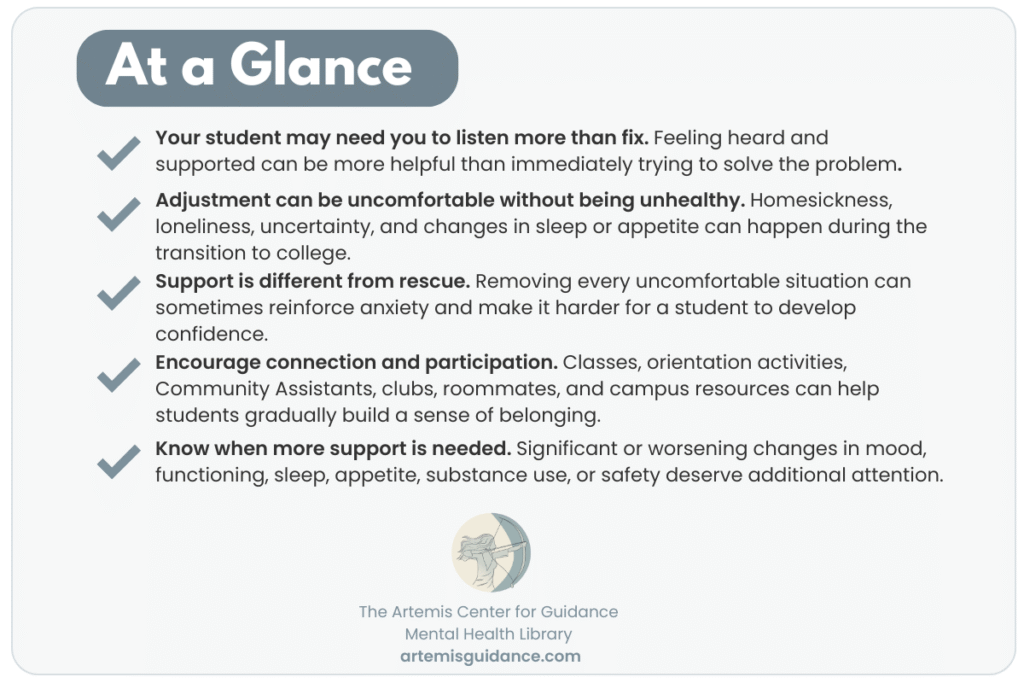
These experiences deserve attention, but they do not automatically mean your student cannot handle college.
Your First Job May Be to Listen
When someone we love is hurting, our instinct is often to make the hurt stop.
Parents are particularly good at this.
For years, when your child had a problem, there was probably something you could do. You scheduled appointments. Talked to teachers. Found the missing uniform. Brought forgotten homework. Helped navigate friendships.
College changes that relationship.
When your student calls and says, “I have no friends,” you may immediately start generating solutions.
Instead, try beginning with curiosity:
“That sounds really lonely. Tell me what today was like.”
Or:
“I’m glad you called me. Do you want me to just listen right now, or do you want help thinking through what you could do next?”
That simple question allows your student to remain in charge of the problem while still knowing you are beside them.
Supporting Your Student Without Rescuing Them
There is an important distinction between supporting distress and removing distress.
This becomes particularly important when anxiety is involved.
Understanding Family Accommodation of Anxiety
Mental health professionals sometimes use the term family accommodation to describe ways family members change their own behavior to help someone avoid or reduce anxiety.
Often, accommodation comes from love.
Imagine your student calls and says they are terrified to attend an orientation event alone.
You could tell them:
“Forget it. You don’t have to go. Stay in your room and FaceTime me tonight.”
That may reduce their anxiety immediately.
But it can also unintentionally reinforce the idea that attending alone really was something they couldn’t handle.
A supportive response might sound more like:
“I know walking in alone sounds awful. What if you went for 20 minutes and gave yourself permission to leave after that?”
The message becomes:
I believe that this is hard, and I also believe you can do hard things.
That balance matters.
Encourage Small Steps Toward Campus Life
Students do not need to find their best friends during orientation week.
They need opportunities for repeated contact.
Encourage your student to keep showing up, even when it feels awkward.
That might mean attending a scheduled orientation activity, eating in a dining hall instead of taking every meal back to the room, sitting near someone in class, going to a club meeting, or asking another student to grab coffee or food.
If they live on campus, their Community Assistant (CA) can also be an important resource. CAs are there not only for practical residential concerns but also to help students navigate campus life and connect with appropriate resources.
Your student does not have to solve college in one week.
They just need to keep participating in it.
Remember: You May Be Hearing the Worst 20 Minutes of Their Day
This is one of the hardest things for parents to remember.
Your student may call you at 4:15 p.m. sobbing because they ate lunch alone.
You spend the rest of the evening worried sick.
Meanwhile, at 6:00, their roommate asks if they want to get dinner. At 7:30, they meet someone from their floor. By 10:00, they’re watching a movie with three people.
And they forget to call you back.
You are still sitting at home carrying the feelings they handed you hours ago.
Try not to assume that the emotional state you hear during a difficult phone call represents your student’s entire experience.
You can check in later:
“How did the rest of the night go?”
Sometimes the answer will surprise you.
Take Care of Your Own Adjustment, Too
Sending a child to college is not only a transition for the student.
It can change the rhythm of an entire household.
Parents may experience sadness, anxiety, pride, loneliness, relief, grief — sometimes all in the same afternoon.
You may also be adjusting to a different role in your child’s life.
They still need you.
But they may need you differently.
Learning to tolerate your own uncertainty can make it easier to give your student room to develop confidence.
Before intervening, it can help to ask yourself:
Am I doing this because my student truly needs intervention — or because I need relief from the discomfort of watching them struggle?
There is no shame in the second answer.
It simply tells you that perhaps you need some support, too.
Sleep, Appetite and Daily Functioning Matter
College routines can disrupt sleep and eating almost immediately.
Late nights, unfamiliar food, early classes, social activity, stress, caffeine, alcohol, and simply being in a different environment can all contribute.
A few difficult nights or temporarily reduced appetite during move-in are different from a pattern that continues or worsens.
Pay attention if your student is consistently unable to sleep, sleeping through much of the day, barely eating, frequently missing classes, neglecting hygiene, or becoming increasingly unable to manage ordinary responsibilities.
Changes in functioning can sometimes tell us more than whether someone says, “I’m fine.”
A Word About Alcohol
Alcohol is present in many college environments, and students make their own choices about whether and how they use it.
The more important mental-health question is sometimes what role alcohol is beginning to play.
Using alcohol primarily to manage anxiety, make social situations tolerable, fall asleep, escape loneliness, or numb distress deserves attention.
Parents can have calm, direct conversations about alcohol without turning every discussion into a lecture.
Curiosity usually keeps communication open better than interrogation.
When Should Parents Be More Concerned?
Some discomfort is expected during adjustment. But “give it time” should never mean ignoring meaningful changes in mental health.
Consider encouraging professional support if your student is experiencing persistent or worsening:
- anxiety or panic
- depression or hopelessness
- social withdrawal or isolation
- significant sleep or appetite disruption
- inability to attend classes or complete basic responsibilities
- frequent or escalating substance use as a way of coping
- distress that is not beginning to improve with time and support
Statements about wanting to die, self-harm, feeling that others would be better off without them, or being unable to stay safe require immediate attention rather than waiting to see whether adjustment improves.
Use the Support Already Around Them
Parents sometimes feel as though they are trying to support their student from miles away while forgetting that there are people physically around the student whose job is to help.
Encourage your student to use Rowan’s campus resources.
That may include their CA, professors, academic support, student organizations, health services, and Rowan University’s Counseling & Psychological Services.
Artemis is a member of the Rowan Partnership, a collaboration between Rowan University and trusted local mental health organizations working to improve access to care, coordinate resources, and support the mental health of the Rowan community.
When appropriate, our team can help students and families understand available options and connect with campus-based resources.
Sometimes the Parent Needs Support, Too
There is another person in this transition whose mental health matters:
You.
If your worry about your student is consuming your days, affecting your sleep, creating conflict with your partner, or making it difficult to know when to step in and when to step back, talking with a therapist can help.
Therapy does not have to be about changing your child.
It can provide a place to work through your own anxiety, grief, changing identity, boundaries, and the complicated experience of parenting an increasingly independent young adult.
For parents located in New Jersey, telehealth can make that support accessible even when life is busy.
This Is a Transition, Not a Verdict
A terrible Tuesday does not tell you how your student’s semester will go.
A lonely first week does not tell you whether they will find their people.
A homesick phone call does not mean they chose the wrong school.
College adjustment is rarely a straight line.
Your student may need encouragement. They may need practical support. They may eventually need professional help.
But sometimes they also need something much simpler:
A parent who can hear “This is really hard” without immediately translating it into “You can’t do this.”
You can hold both truths at once:
This is hard.
And I believe you can find your way through it.
A note from Artemis: This topic is especially close to our practice. The founder of The Artemis Center for Guidance is both a Rowan University alumna and a Rowan parent. Artemis is also a member of the Rowan Partnership, a collaboration between Rowan University and local mental health organizations working to improve access to care and support the mental health of the Rowan community.
When you’re ready, we’re here.
College is an adjustment for families, too. If you’re a parent in New Jersey and would like support navigating anxiety, changing family roles, boundaries, or the transition to parenting a young adult, our team is here to help.


