

You know which appointment needs to be scheduled, which bill is coming due, and which conversation needs a follow-up. You notice when supplies are running low. You remember the form that has to be signed.
Other people may help. They may care deeply. Still, you are often the person who keeps track of what needs to happen.
By the end of the day, you may struggle to explain why you are so tired. Things got done. Nothing dramatic happened. But your mind has been working in the background the whole time.
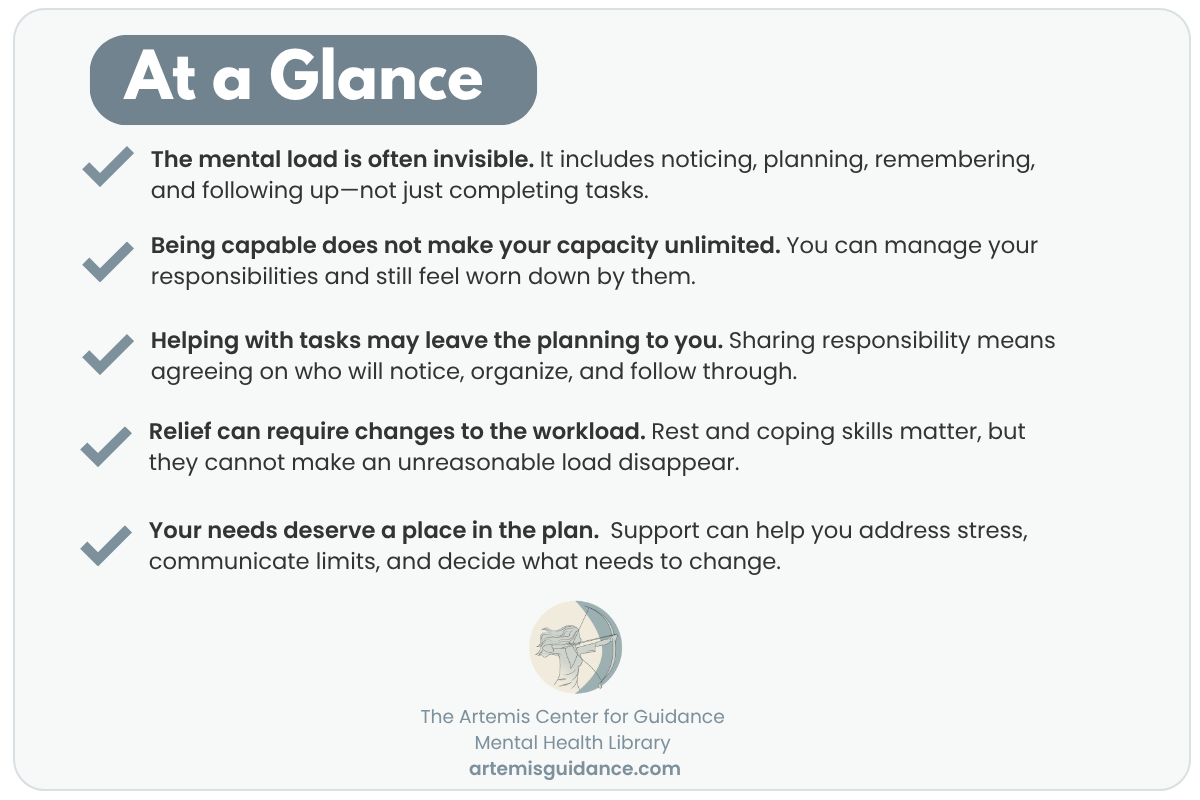
That ongoing work is often called the mental load. When too much of it rests on one person, being responsible can become exhausting.
What Is the Mental Load?
The mental load is the thinking and planning involved in managing everyday responsibilities. It includes anticipating needs, considering options, making decisions, and checking that things have been completed.
Scheduling an appointment, for example, may involve much more than making a phone call. Someone has to notice it is needed, find a provider, check availability, arrange transportation, and remember any follow-up.
Researchers studying household labor have described these mental steps as a distinct part of the work. They can be easy to overlook because they do not always produce a visible result.
Similar experiences can occur at work and in caregiving, although those settings have their own demands.
“Mental load” is a useful description of an experience. It is not a mental health diagnosis.
Why It Can Be Hard to Put Down
A physical task often has a clear ending. The dishes are washed. The email is sent.
Responsibility can stay with you after the task is finished. You may be thinking about the next deadline or wondering whether someone followed through. Even during a break, part of your attention may remain on what could be missed.
There can also be pressure in knowing that other people depend on you. You might feel proud of being reliable and frustrated that so much depends on your attention. Both feelings can be true.
A study of 322 mothers of young children found that carrying a greater share of household planning was associated with more stress, depressive symptoms, and burnout, among other difficulties. The study relied on self-reports and does not prove that mental load caused those symptoms. It also does not describe every family or every person’s experience.
It does, however, support taking this often unseen work seriously.
How Carrying Too Much May Feel
You might notice:
- Trouble relaxing because your mind keeps returning to unfinished responsibilities.
- Irritation when someone asks what needs to be done.
- Feeling overwhelmed by one more small decision.
- Resentment, even toward people you love.
- Less room for hobbies, connection, or your own needs.
- Feeling that everything will fall behind if you stop paying attention.
These experiences can have several causes. They do not, by themselves, mean you have an anxiety disorder or another condition. They are reasons to look at how much you are carrying and how it is affecting you.
Getting everything done is not the only measure of whether a workload is manageable. The effort it takes—and what is left of you afterward—also matters.
How Someone Becomes the Default Responsible Person
Sometimes responsibilities settle around whoever has the most experience, flexibility, or attention to detail. Sometimes they reflect family expectations, workplace roles, financial limits, or another person’s illness or disability.
You may have learned that noticing problems early keeps life more predictable. You may have had real experiences of things being missed unless you stepped in.
At other times, worry or high standards may make it difficult to let someone else handle a task differently.
These possibilities can overlap. It is worth asking both: “Am I taking on something I could release?” and “Am I being left with something that should be shared?”
Carrying too much is not automatically evidence that you have poor boundaries. Some people are working within demands that genuinely exceed the support available.
What Can Help Reduce the Mental Load?
Make the invisible work visible
Choose one area that feels especially heavy. Write down the thinking behind it, along with the tasks.
For meals, that might include checking supplies, deciding what to eat, considering dietary needs, shopping, cooking, and planning around schedules.
The purpose is to help everyone understand what the responsibility actually involves. Keep it simple; you do not need a detailed tracking system for your entire life.
Share ownership, including the planning
“I’ll help if you tell me what to do” may provide some relief while leaving you responsible for noticing, assigning, and checking.
Where possible, agree on ownership of a whole responsibility.
For example: “Could you take responsibility for groceries this month, including checking what we need, making the list, and arranging the shopping?”
Agree on the budget, timing, and essential needs. Then discuss how the person taking ownership will manage reminders and follow-up.
At work, a similar conversation might be: “Who owns this task, when is it due, and how will they flag a problem?”
Shared responsibility works best when people also have the information, time, and authority needed to carry it.
Separate essential standards from preferences
Some requirements protect health, safety, or important obligations. Others are preferences about how something gets done.
If someone else can complete a task safely and adequately in a different way, allowing that difference may reduce how much you need to supervise.
That does not mean accepting repeated failures or ignoring meaningful consequences. It means deciding where flexibility is possible.
Ask what can be reduced or postponed
Sometimes there is more work than the available people can reasonably do.
In that situation, redistribution alone may not be enough. Consider whether a commitment can pause, a routine can become simpler, or a deadline can be renegotiated.
You might say: “I can finish this by Friday, or take on the new request today. I cannot do both within the time available. Which is the priority?”
If you live alone or have limited support, relief may depend more on reducing demands, using reminders, or finding practical resources. Advice to “just delegate” may not fit your circumstances.
Make room for rest without another assignment
You do not need to turn rest into a new project to manage.
A short break, a quieter evening, or time away from messages may offer some relief. But if the workload stays unreasonable, breaks alone may not be enough.
It is reasonable to need both time to recover and changes to what you are expected to carry.
When Therapy May Help
Therapy may be useful when stress is affecting your sleep, mood, relationships, concentration, or enjoyment of daily life.
It can provide space to explore why responsibility feels difficult to release, practice conversations about limits, and address worry or guilt. It can also help you distinguish between demands that need to change and fears that make change harder.
If worry extends beyond your responsibilities, learning more about what anxiety recovery can look like may help you consider what support you need.
Therapy cannot create more hours in the day or make other people follow through. Practical support and changes at home or work may be needed alongside it.
You do not have to wait for a crisis to ask for help. Continuing to function does not mean the strain deserves no attention.
If you have persistent fatigue, new physical symptoms, or significant changes in sleep, a medical evaluation is also appropriate rather than assuming stress explains everything.
Being Responsible Can Include Caring for Yourself
You may value being dependable. You may find meaning in caring for people and doing your work well. Those parts of you do not need to disappear.
But your needs belong in the picture, too.
A manageable life has room for responsibility, support, limits, and rest. You do not have to wait until you can no longer keep things running before considering what it is costing you.
Being someone others can count on can include counting your own well-being among the things worth protecting.
References
Daminger, A. (2019). The cognitive dimension of household labor. American Sociological Review, 84(4), 609–633. https://doi.org/10.1177/0003122419859007
Aviv, E., et al. (2024). Cognitive household labor: Gender disparities and consequences for maternal mental health and wellbeing. Archives of Women’s Mental Health. https://doi.org/10.1007/s00737-024-01490-w