

Parents often ask a deceptively simple question:
How do I know if my child needs therapy?
There is no single behavior, symptom, or checklist that can answer that question for every child.
Children have bad days. They become anxious about new situations. They argue with parents, struggle with friends, worry about school, and sometimes go through phases that leave the adults around them wondering what happened to the child they knew last month.
Much of this is part of growing up.
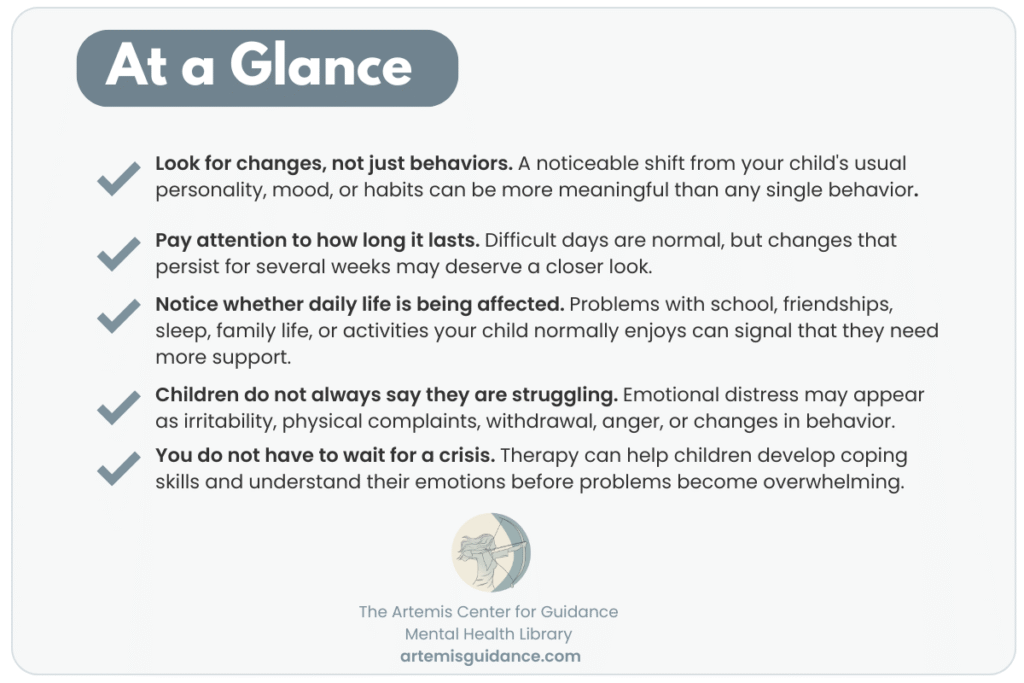
What tends to matter more is whether something has changed, how long it has been happening, and how much it is affecting your child’s everyday life.
A child does not need to be in crisis to benefit from therapy. Sometimes therapy is appropriate because a child is struggling. Other times, a child simply needs a safe place to develop skills for handling something difficult.
Here are eight signs worth paying attention to.
1. Their Mood or Personality Seems Different
You know your child better than anyone.
Maybe your normally talkative child has become unusually quiet. Your easygoing child seems angry all the time. Your affectionate child suddenly wants everyone to leave them alone.
Not every change means something is wrong. Children change as they grow, and mood shifts can happen during stressful periods or developmental transitions.
The question to ask is:
Does this feel noticeably different from my child’s usual self?
Persistent sadness, irritability, tearfulness, anger, emotional sensitivity, or seeming emotionally “flat” may be signs that your child is having a harder time than they know how to explain.
This is especially worth exploring when the change lasts for several weeks or begins affecting other parts of life.
2. Worry or Fear Is Getting in the Way
Anxiety is a normal human emotion — including for children.
A child may worry before the first day of school, feel nervous about a test, or need reassurance before trying something new. Anxiety becomes more concerning when it begins determining what a child can and cannot do.
You might notice:
- Frequent reassurance seeking
- Avoiding school or activities
- Refusing to sleep alone after previously doing so comfortably
- Intense fear of making mistakes
- Difficulty separating from caregivers
- Frequent “what if?” questions
- Avoiding friends, sports, parties, or other situations because of fear
The goal is not for children to never feel anxious. It is to help them learn that they can experience anxiety without allowing it to make their world smaller.
Therapy can help children understand anxiety, recognize how it shows up in their bodies and thoughts, and practice skills for responding to it.
3. You Are Seeing More Anger, Meltdowns, or Irritability
Adults sometimes expect emotional distress to look like sadness.
In children, it often doesn’t.
Anxiety, sadness, frustration, overwhelm, grief, and stress can all appear as irritability or anger. Younger children especially may communicate through behavior because they do not yet have the language or emotional awareness to explain what they are experiencing.
You may see:
- More frequent tantrums or meltdowns
- Disproportionate reactions to small problems
- Increased arguing
- Aggression toward siblings or caregivers
- Difficulty recovering after becoming upset
- Constant irritability or frustration
This does not mean every angry child needs therapy. Anger is an emotion, not a diagnosis.
But when emotional reactions are becoming frequent, intense, difficult to recover from, or disruptive to family or school life, it may be useful to explore what is underneath them.
4. They Are Withdrawing From Friends or Activities
Children’s interests naturally change.
A child quitting soccer because they discovered theater is very different from a child who suddenly stops wanting to do anything they previously enjoyed.
Pay attention when a child begins consistently withdrawing from:
- Friends
- Family
- Sports or clubs
- Hobbies
- Social events
- Activities they previously enjoyed
Sometimes withdrawal reflects anxiety. Sometimes it is related to low mood, bullying, friendship problems, embarrassment, stress, or feeling overwhelmed.
And sometimes children simply need more downtime.
Again, change from baseline matters.
If your child has always preferred one or two close friends and quiet activities, that is different from a highly social child suddenly isolating themselves.
5. School Has Become Much Harder
A sudden change in school performance does not necessarily mean a child is unmotivated or “not trying.”
Emotional difficulties can affect concentration, memory, motivation, organization, attendance, and the ability to complete work.
Parents might notice:
- Falling grades
- Difficulty concentrating
- Refusing or resisting school
- Frequent visits to the school nurse
- Missing assignments
- Increased conflict about homework
- A child who previously managed school becoming overwhelmed
There are many possible reasons for school difficulties, including learning differences, attention problems, bullying, sleep difficulties, medical concerns, family stress, or mental health symptoms.
Therapy may be one part of understanding what is happening, but it should not automatically be assumed that every academic problem is psychological.
Communication with teachers, school support staff, and your child’s healthcare provider can sometimes help build a fuller picture.
6. Sleep, Eating, or Physical Complaints Have Changed
Children often experience emotions physically.
A child who cannot explain, “I feel anxious about school,” may instead repeatedly say their stomach hurts on Sunday night.
Parents may notice:
- Difficulty falling or staying asleep
- Sleeping much more than usual
- Frequent nightmares
- Significant changes in appetite
- Headaches or stomachaches
- Feeling sick before school or certain activities
- Unexplained fatigue
Physical symptoms should not automatically be attributed to anxiety or stress.
New, persistent, or concerning physical symptoms deserve appropriate medical evaluation.
When medical causes have been considered and symptoms seem connected to stress or emotions, therapy may help a child learn to recognize the relationship between what they feel emotionally and what they experience physically.
7. Something Difficult Has Happened
Children do not need to show obvious symptoms before receiving support after a difficult experience.
Events that can affect children include:
- Divorce or separation
- Death of someone important
- Moving
- Changing schools
- Serious illness in the family
- Friendship loss
- Bullying
- A frightening experience
- Family conflict
- A parent’s absence or deployment
- Other significant changes or losses
Children respond to difficult experiences differently. Some talk constantly about what happened. Others barely mention it. Some seem fine initially and struggle later.
Therapy can provide a neutral place for a child to process what happened without feeling responsible for protecting a parent’s feelings.
Seeking support does not necessarily mean an experience has “traumatized” a child. Sometimes it simply means recognizing that something important happened and giving the child another safe place to make sense of it.
8. Your Child Is Telling You They Need Help
This one deserves special attention.
If your child or teenager tells you:
“I think I want to talk to someone.”
Listen.
They may not be able to explain exactly why.
Children sometimes know they are struggling before adults can see the extent of it. Older children and teenagers may also find it easier to discuss certain feelings with someone outside their family.
Wanting a therapist does not mean your relationship with your child has failed.
In fact, one of the most supportive things a parent can sometimes say is:
“Okay. Let’s find someone you feel comfortable talking to.”
What Matters More Than Any Checklist?
When deciding whether to seek professional support, consider three things:
Change
Is this different from your child’s usual behavior, personality, or functioning?
Duration
Has it continued beyond a brief reaction to a stressful day or situation?
Impact
Is it interfering with school, friendships, family relationships, sleep, activities, or your child’s ability to enjoy everyday life?
You do not need all three to ask for help, and you certainly do not need to count how many items on this list apply.
These are guides, not rules.
What If I’m Not Sure?
It is completely reasonable to be unsure.
Parents sometimes hesitate to contact a therapist because they worry their child’s problem is not “serious enough.”
Therapy does not have to begin at the point of crisis.
An initial evaluation can help a family better understand what is happening and whether ongoing therapy makes sense. Sometimes treatment is recommended. Sometimes another type of evaluation or support is more appropriate. Sometimes parents simply leave with a better understanding of what they are seeing and what to watch for.
The purpose of an evaluation should not be to find something wrong with a child.
It should be to understand them better.
Therapy Should Fit the Child
Children are not small adults, and effective therapy with children often looks different from adult therapy.
Depending on a child’s age and needs, treatment may involve conversation, play, creative activities, skill-building, behavioral strategies, parent involvement, or a combination of approaches.
Parents and caregivers are often an important part of treatment, particularly for younger children.
At the same time, children and teenagers need an appropriate level of privacy to build trust with their therapist. A therapist can help families understand how confidentiality works and how parents can remain meaningfully involved while still giving a child space to talk openly.
Most importantly, the relationship matters.
A child should gradually feel that therapy is a place where they are understood, respected, and safe enough to be themselves.
When to Seek Help More Quickly
Some situations should not wait for a routine therapy appointment.
If a child talks about wanting to die, harming themselves, harming someone else, or you believe they may be in immediate danger, seek urgent help right away. You can call or text 988 to reach the Suicide & Crisis Lifeline, call 911, or go to your nearest emergency room.
Similarly, severe changes in behavior, confusion, hallucinations, inability to function, significant changes in eating or drinking, or other sudden and concerning symptoms may require prompt medical or mental health evaluation. In these situations, you can also go directly to a local emergency department or call 911 if there is immediate risk.
For children and teens in New Jersey, families can also contact PerformCare (1-877-652-7624), which helps connect youth to urgent behavioral health services and mobile crisis support when needed.
Parents do not need to determine the diagnosis before asking for help.
If something feels significantly wrong, it is appropriate to have your child evaluated.
You Know Your Child — And You Don’t Have to Know Everything
Parents sometimes feel as though they should automatically know what their child needs.
That is an impossible standard.
You can know your child deeply and still not understand why they are struggling. Children themselves often do not understand it yet.
Asking for help does not mean assuming something is wrong with your child.
Sometimes it simply means saying:
“Something seems harder for you lately, and I want to understand.”
That can be a powerful place to begin.


