

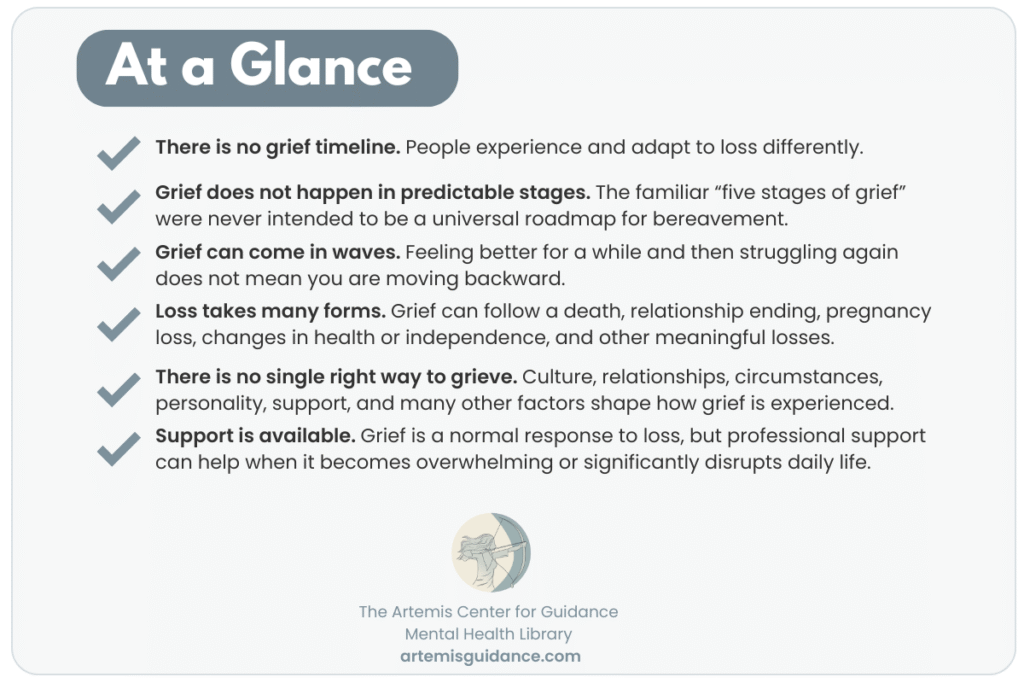
Grief Doesn’t Follow a Timeline
When someone we love dies, even ordinary parts of life can suddenly feel different.
A song, photograph, holiday, familiar place, or seemingly insignificant moment can bring the loss sharply back into focus.
At the same time, people are often surrounded by messages about what grief is supposed to look like.
You may have heard that grief happens in five stages. You may have been told that you need to “move on.” You may wonder why you had several good days and suddenly feel devastated again.
Or you may find yourself wondering:
Why am I still struggling?
Why am I not crying more?
Shouldn’t I be doing better by now?
The answer is important:
There is no single way to grieve, and there is no schedule you are supposed to follow.
Research on bereavement has identified multiple patterns of adjustment following loss. Some people experience intense distress that gradually becomes less overwhelming. Others experience more persistent difficulty. Some people remain relatively resilient even while deeply missing the person who died.
None of these experiences can be reduced to one universal sequence.
What About the “Five Stages of Grief”?
The idea of five stages—denial, anger, bargaining, depression, and acceptance—is deeply embedded in popular culture.
But its history is often misunderstood.
Psychiatrist Elisabeth Kübler-Ross introduced these concepts in her 1969 book On Death and Dying. Her work primarily described experiences she observed among people confronting their own terminal illnesses. It was not originally developed as a scientifically established sequence that bereaved people were expected to follow after someone else died.
Over time, however, the five stages became widely presented as a roadmap for grief.
Research does not support using them that way.
A grieving person may experience disbelief, anger, regret, profound sadness, moments of acceptance, or many other emotions. Those experiences are real.
What is not supported is the expectation that everyone will experience five particular stages, experience all of them, or move through them in a particular order.
For some people, the language of the stages may help describe something they are feeling.
For others, it may not fit at all.
Grief is not a checklist you have to complete.
What Can Grief Actually Look Like?
Grief can affect far more than sadness.
It may involve:
- Longing or missing the person who died
- Shock or disbelief
- Anger
- Guilt or regret
- Relief
- Loneliness
- Anxiety
- Difficulty concentrating
- Changes in sleep or appetite
- Fatigue
- Feeling emotionally numb
- Difficulty imagining the future
- Wanting to talk about the person frequently
- Not wanting to talk about the loss at all
Some of these experiences may occur together. Others may come and go.
You may even experience emotions that seem contradictory.
Someone can feel devastated by a death and also experience relief that a loved one’s suffering has ended.
You can deeply miss someone and still laugh with a friend.
You can have a wonderful day and still be grieving.
Grief does not require you to feel one particular way all the time.
Grief Can Come in Waves
Many people expect grief to gradually become less painful each day.
Real life is rarely that orderly.
You may feel relatively okay for several days or weeks and suddenly become overwhelmed after hearing a familiar song, seeing an old photograph, visiting a meaningful place, or reaching an anniversary.
Sometimes the reminder is obvious.
Sometimes grief seems to appear without warning.
These experiences do not necessarily mean you are “back at the beginning.”
A difficult day does not erase the days that came before it.
And a good day does not mean you have finished grieving.
Moving Between Grief and Everyday Life
One contemporary way of understanding bereavement is the Dual Process Model of Coping with Bereavement, developed by researchers Margaret Stroebe and Henk Schut.
Rather than describing grief as a series of stages, the model recognizes that people may move back and forth between attending to their loss and adapting to everyday life.
Loss-oriented coping may include missing the person, thinking about the death, remembering, crying, or processing painful emotions.
Restoration-oriented coping may involve going to work, caring for children, managing responsibilities, developing new routines, spending time with friends, or figuring out how to handle things the person who died once did.
Neither is more legitimate than the other.
People need opportunities to engage with grief—and opportunities to step away from it.
You might spend an afternoon looking through photographs and crying, then watch a television show and laugh that evening.
That does not mean you have forgotten.
Taking a break from grief is not the same as leaving someone behind.
Grief Can Follow Many Kinds of Loss
We often associate grief with death.
But people can grieve many kinds of meaningful losses.
These may include:
- The end of a relationship or marriage
- Pregnancy loss
- Infertility
- Changes in health or physical ability
- Loss of independence
- Losing a job or career
- Moving away from a community
- Estrangement from a family member
- A major change in identity or role
- A hoped-for future that will no longer happen
Some losses are openly recognized by the people around us.
Others are not.
Disenfranchised grief describes grief that is not fully acknowledged, socially recognized, or supported by others.
That can make an already painful experience particularly isolating.
You do not need someone else to consider a loss significant for your feelings to be real.
Why Everyone Experiences Grief Differently
Your experience of grief may be shaped by many things, including:
- Your relationship to the person or thing you lost
- The circumstances surrounding the loss
- Whether the loss was sudden or expected
- Previous experiences with loss
- Your personality and coping style
- Cultural, spiritual, or religious beliefs
- Your support system
- Other stressors happening at the same time
- Your responsibilities following the loss
Two people can experience the same loss and respond very differently.
One person may want to talk constantly.
Another may need quiet.
One person may cry frequently while another rarely cries.
Someone may return to work quickly because routine helps them cope. Another may struggle to concentrate for some time.
How visibly someone expresses grief is not a measurement of how deeply the loss affects them.
Ways to Cope With Grief
There is no strategy that makes grief disappear.
There are, however, ways to support yourself while moving through it.
Stay Connected
Let trusted people know what you need when you can.
Sometimes you may want to talk about the person or loss.
Other times, you may simply want someone nearby—or practical help with meals, errands, childcare, or other responsibilities.
Take Care of Basic Needs
Grief can affect sleep, appetite, concentration, and energy.
Eating regularly, drinking water, resting, taking prescribed medications, and getting some movement may sound simple, but basic care can become difficult during intense grief.
Doing what you can is enough.
Make Room for Memories
Photographs, music, journaling, traditions, storytelling, religious or cultural practices, and personal rituals may provide ways to maintain a meaningful connection with someone who died.
There is no requirement to remove reminders or “let go” on someone else’s schedule.
Expect Difficult Days
Birthdays, holidays, anniversaries, family events, and unexpected reminders can bring grief back to the surface.
When you know a difficult date is approaching, it may help to think ahead about what you want the day to look like and who you want around you.
Allow Moments of Happiness
Enjoying something does not diminish the significance of your loss.
You do not have to remain visibly sad to demonstrate that someone mattered to you.
Joy and grief can exist at the same time.
When Might Grief Need More Support?
Grief is a normal response to loss.
There is no particular number of weeks or months after which someone should automatically be “over it.”
But normal grief can still be enormously difficult, and you do not have to wait until you are in crisis to seek support.
Consider talking with a mental health professional if:
- Grief is significantly interfering with work, school, relationships, or daily responsibilities.
- You feel persistently disconnected from your life or other people.
- You are experiencing severe anxiety, depression, or trauma-related symptoms.
- You are relying heavily on alcohol or other substances to cope.
- Your grief feels increasingly overwhelming or unmanageable.
- You feel unable to imagine a meaningful future.
- You are concerned about how you are coping.
Therapy does not need to make grief disappear.
It can provide a place to understand what you are experiencing, talk openly about the loss, develop ways of coping with difficult moments, and begin adapting to what has changed.
What Is Prolonged Grief Disorder?
For some people, grief following the death of someone close remains intensely distressing and significantly disruptive over time.
Prolonged grief disorder (PGD) is a recognized mental health condition involving persistent and severe grief following bereavement.
Under DSM-5-TR criteria, diagnosis in adults requires that the death occurred at least 12 months earlier, along with specific symptoms, clinically significant distress or impairment, and consideration of relevant social, cultural, and religious norms.
This distinction matters.
Grieving someone for longer than a year does not mean you have prolonged grief disorder.
People can continue loving, missing, remembering, and grieving someone for decades without having a mental health disorder.
PGD describes a particular pattern of persistent symptoms and impairment. It is not a deadline for grief.
If you are concerned about what you are experiencing, you do not need to determine the diagnosis yourself. A qualified mental health professional can help you understand what may be happening and what kind of support could be useful.
You Don’t Have to “Get Over” Grief
Healing after loss does not necessarily mean forgetting.
It does not require leaving the person behind or reaching a point where the loss no longer matters.
For many people, adapting to loss means gradually learning how to live in a changed world while continuing to carry memories, relationships, values, and love forward.
There may be days when you feel strong.
There may be days when grief surprises you again.
Both can be part of adapting to loss.
You do not need to meet an imaginary deadline.
You do not need to experience five stages.
You do not need to grieve like anyone else.
There is no perfect way to grieve.
Sources & Further Reading
Contemporary grief and bereavement research
Bonanno, G. A., et al. (2002). Resilience to loss and chronic grief: A prospective study from preloss to 18-months postloss. Journal of Personality and Social Psychology, 83(5), 1150–1164.
Stroebe, M., Schut, H., & Boerner, K. (2017). Cautioning health-care professionals: Bereaved persons are misguided through the stages of grief. OMEGA—Journal of Death and Dying, 74(4), 455–473.
Five stages and Kübler-Ross
Kübler-Ross, E. (1969). On Death and Dying. Scribner.
O’Connor, M. F. (2020). Should we incorporate the work of Elisabeth Kübler-Ross in our current teaching and practice and, if so, how? OMEGA—Journal of Death and Dying.
Dual Process Model
Stroebe, M., & Schut, H. (1999). The Dual Process Model of Coping with Bereavement: Rationale and description. Death Studies, 23(3), 197–224.
Johannsen, M., et al. (2019). A systematic review of the Dual Process Model of Coping With Bereavement (1999–2016). OMEGA—Journal of Death and Dying.
Non-death loss and disenfranchised grief
Harris, D. L. (Ed.). (2019). Non-Death Loss and Grief: Context and Clinical Implications. Routledge.
Doka, K. J. (Ed.). (1989). Disenfranchised Grief: Recognizing Hidden Sorrow. Lexington Books.
Prolonged grief disorder
American Psychiatric Association. Diagnostic and Statistical Manual of Mental Disorders, Fifth Edition, Text Revision (DSM-5-TR): Prolonged Grief Disorder.