
Back-to-school season is usually discussed in terms of students.
Will children adjust to a new classroom? Will teenagers manage the workload? How can parents help with first-day nerves?
But students are not the only people making a major transition when a new school year begins.
For teachers, returning to school can mean an abrupt change in routine, increased responsibility, new students, new expectations, less control over their time, and the return of a workload that can be difficult to leave at work.
Even teachers who love what they do may find themselves feeling anxious, irritable, overwhelmed, or simply not quite like themselves as the school year begins.
And sometimes that feeling doesn’t disappear after the first day.
Why Can Going Back to School Feel So Difficult for Teachers?
Summer can create a very different rhythm of life.
Even teachers who work during the summer may have more flexibility around when they wake up, eat, exercise, spend time with family, complete errands, or simply have time to themselves.
Then the school year begins.
Suddenly, the alarm is going off earlier. The commute is back. There are lesson plans, meetings, emails, classroom responsibilities, student needs, parent communication, administrative expectations, and decisions to make throughout the day.
That is a significant transition for the mind and body.
Feeling unsettled during that transition doesn’t necessarily mean something is wrong. Humans generally do better when life feels somewhat predictable, and the beginning of a school year introduces a great deal of change all at once.
Teacher Anxiety Doesn’t Always Look Like Worry
When we think about anxiety, we often picture someone who feels nervous or afraid.
But anxiety can show up in less obvious ways.
A teacher struggling with anxiety or stress might notice:
- Difficulty falling asleep despite feeling exhausted
- Waking up thinking about school
- Irritability with family, coworkers, or students
- Muscle tension, headaches, or stomach problems
- Constantly mentally reviewing what needs to be done
- Difficulty concentrating or making decisions
- Feeling unable to relax after leaving school
- Dreading Sunday evenings
- Feeling overwhelmed by tasks that would normally feel manageable
- Checking email or school systems repeatedly
- Feeling emotionally depleted by the end of the day
None of these experiences automatically means someone has an anxiety disorder.
They can, however, be signs that your nervous system is having difficulty adjusting to the demands being placed on it.
“But I’ve Been Teaching for Years”
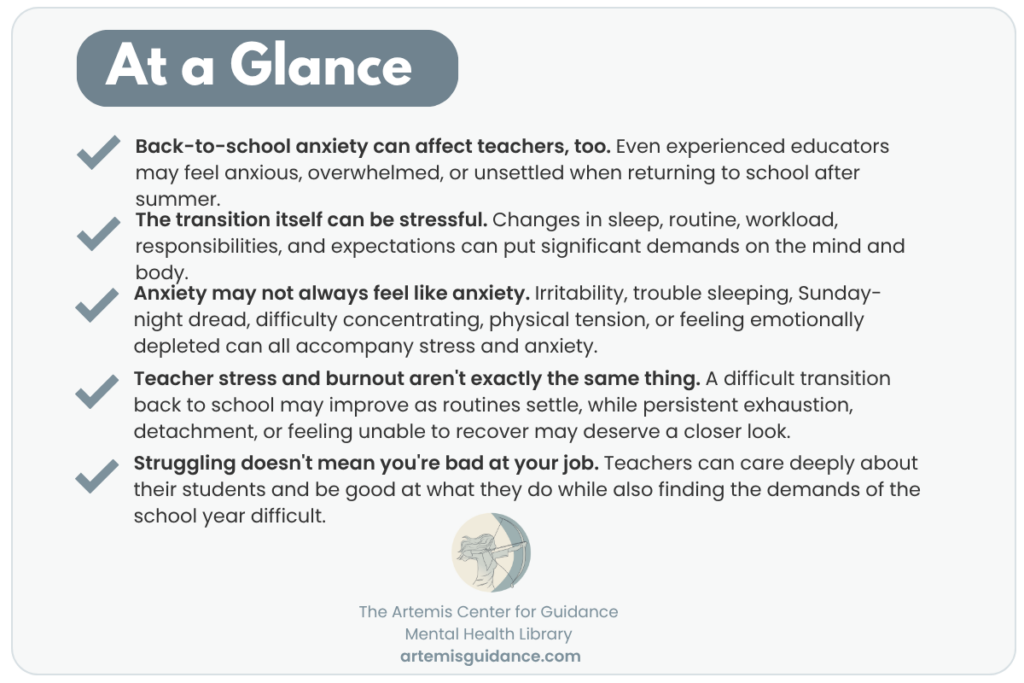
Experience doesn’t necessarily make someone immune to back-to-school anxiety.
In fact, experienced teachers may enter a new school year already knowing exactly how demanding the coming months can become.
There may also be new challenges each year: a different class, changing curriculum requirements, staffing shortages, administrative changes, difficult experiences from the previous year, or concerns about particular students.
Sometimes knowing what is coming can create its own kind of anticipatory anxiety.
You can be highly competent at your job and still feel anxious about doing it.
Those two things are not contradictory.
Teachers Carry More Than a Lesson Plan
Teaching involves a tremendous amount of emotional work.
Throughout a school day, teachers may need to manage their own emotions while responding to the emotions and needs of many other people.
A student may be struggling academically. Another may be having difficulties at home. A parent may be upset. A colleague may need support. An administrator may introduce another responsibility into an already full day.
Meanwhile, the teacher is expected to remain patient, attentive, organized, encouraging, and emotionally available.
That doesn’t mean teaching is inherently unhealthy or that teachers cannot find tremendous meaning and satisfaction in their work.
It does mean that the emotional demands of the profession are real.
Caring deeply about students can be one of the most rewarding parts of teaching. It can also make it harder to mentally leave work at work.
When Sunday Night Starts on Saturday
Many people experience some version of the “Sunday scaries”—the uneasy feeling that appears as the weekend ends and the workweek approaches.
For teachers experiencing significant stress, that feeling can sometimes begin much earlier.
Saturday afternoon becomes Sunday morning in your mind. You start thinking about what needs to be prepared. You remember the email you haven’t answered. You wonder whether Monday’s lesson will work. You think about the student you’re worried about.
Before you know it, much of the time that was supposed to help you recover has become occupied by anticipating work.
That pattern can become exhausting.
If you notice that anxiety about returning to school is regularly consuming your evenings or weekends, it may be worth paying attention to rather than simply accepting it as part of being a teacher.
Is It Anxiety, Stress, or Teacher Burnout?
These terms are often used interchangeably, but they aren’t exactly the same.
Stress is a normal response to demands or pressure. A particularly busy week, difficult classroom situation, or beginning-of-year transition can create stress that improves when the situation settles.
Anxiety can involve persistent worry, fear, physical tension, or a sense of threat that may continue even when there isn’t an immediate problem to solve.
Burnout is generally associated with prolonged workplace stress and may involve exhaustion, detachment or cynicism, and a reduced sense of effectiveness.
The World Health Organization describes burnout as an occupational phenomenon resulting from chronic workplace stress that has not been successfully managed.
These experiences can also overlap.
A teacher may be stressed by the beginning of the school year, anxious about particular responsibilities, and already carrying exhaustion from previous years.
You don’t need to determine the perfect label before deciding that something deserves your attention.
When the School Year Doesn’t “Settle Down”
It is reasonable to expect some adjustment when returning to school.
The first few weeks may be tiring. Routines are still developing. Teachers and students are learning one another. Schedules change. Problems appear that nobody anticipated in August.
For many people, things begin to feel more manageable once those routines become familiar.
But sometimes they don’t.
You may notice that you’re still waking up with dread weeks into the school year. Perhaps you’re crying more easily, having difficulty sleeping, withdrawing from people you care about, or spending most of the weekend recovering enough to return on Monday.
Maybe you’re functioning perfectly well at school, but doing so takes nearly everything you have.
That distinction matters.
Being able to keep performing your responsibilities doesn’t necessarily mean the stress isn’t affecting you.
What Actually Helps With Back-to-School Anxiety?
Advice for stressed teachers can sometimes become another list of things they’re supposed to accomplish.
Exercise. Meditate. Meal prep. Journal. Get eight hours of sleep. Practice gratitude.
Those things may be helpful for some people, but self-care should not become another assignment you’re failing to complete.
Sometimes the first useful step is simply noticing what is actually happening.
Is your anxiety strongest on Sunday evenings? Does checking school email at home make it harder to disengage? Are you skipping lunch because there never seems to be enough time? Are you saying yes to responsibilities when you are already overwhelmed? Are you spending your entire weekend preparing for the coming week?
Small boundaries can matter.
That might mean choosing a time when you stop checking work email, protecting part of the weekend from schoolwork, asking for help when something is genuinely unmanageable, or deliberately creating a transition between the school day and home.
The goal isn’t to perfectly eliminate stress.
It is to create enough recovery that work doesn’t consume every part of your life.
You Can Love Teaching and Still Struggle With Teaching
This may be one of the most important distinctions.
Feeling anxious about school does not necessarily mean you’ve chosen the wrong profession.
Feeling exhausted doesn’t mean you don’t care about your students.
Wanting stronger boundaries doesn’t make you selfish.
And struggling with the demands of teaching does not mean you’re bad at your job.
Two things can be true at once: you can care deeply about the work you do and recognize that the work is taking a toll on you.
When Might It Help to Talk With Someone?
Not every difficult transition requires therapy.
But it may be worth considering additional support when anxiety or stress begins interfering with sleep, relationships, physical well-being, concentration, or your ability to enjoy the parts of life that happen outside school.
Therapy can also be useful before things reach a crisis point.
You don’t need to wait until you are completely burned out or unable to go to work.
Sometimes therapy simply provides a place where the person who spends all day caring for, teaching, guiding, and responding to other people gets to focus on what they need.
The beginning of a school year asks teachers to make room for a new group of students.
It is reasonable to make some room for yourself, too.