

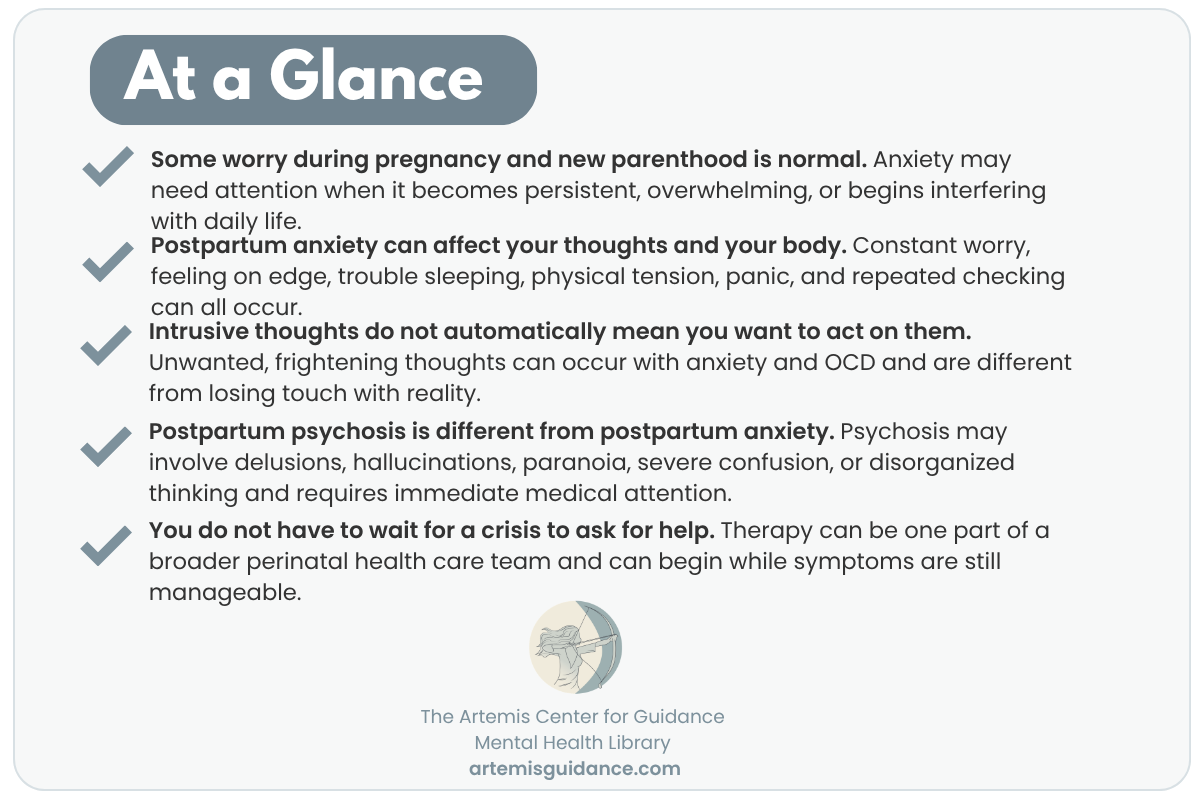
Having a baby brings enormous change. Suddenly there is a new person to know, care for, and fit into a life that may already have been full.
It is normal for your attention to shift toward your baby’s needs and safety. But sometimes that awareness becomes anxiety that is difficult to turn off.
You may know logically that your baby is safe but still feel unable to relax. You might repeatedly check the monitor, search symptoms online, seek reassurance, or imagine terrible things happening. You may feel exhausted but unable to sleep because your mind will not quiet down.
You might wonder: Is this just what becoming a parent feels like?
Sometimes it isn’t.
Anxiety can begin for the first time during pregnancy or after delivery, and existing anxiety can also become more difficult during this period.[1]
What Is Perinatal Anxiety?
“Perinatal” refers to the period during pregnancy and after childbirth. Perinatal anxiety is not one single diagnosis. It can include generalized anxiety, panic, social anxiety, and other anxiety-related conditions occurring during pregnancy or the postpartum period.[2]
Anxiety itself is not inherently unhealthy. It is part of the body’s alarm system. It helps us notice potential problems and respond to them.
The problem is when that alarm becomes too sensitive.
An anxiety disorder is different from temporary worry. Anxiety may become a clinical concern when it is intense, lasts for a long time, or begins interfering with daily life.[1]
If you’re wondering whether anxiety can actually get better, read Can Anxiety Go Away? What Recovery From Anxiety Actually Looks Like.
During pregnancy or postpartum, that distinction can be confusing. Your life really has changed. Your body may have changed. Your sleep may have changed dramatically. Your routines, relationships, and responsibilities may all look different.
So the question isn’t simply:
“Am I worried?”
A more useful question may be:
“How much of my life is this worry taking over?”
What Can Postpartum Anxiety Feel Like?
It doesn’t look exactly the same for everyone.
For some people, anxiety is mostly mental:
- constant “what if” thoughts
- expecting something terrible to happen
- difficulty concentrating
- repeatedly needing reassurance
- feeling unable to trust your own judgment
For others, it is very physical:
- racing heart
- nausea or stomach discomfort
- dizziness
- muscle tension
- difficulty sleeping
- feeling restless or constantly on alert
Anxiety can also change behavior. You may begin avoiding things that feel unsafe or find yourself constantly watching for danger.[1]
Sometimes anxiety becomes focused specifically on the baby.
You may find yourself checking whether the baby is breathing again and again. You may become terrified of leaving the baby with someone else. Driving with the baby may suddenly feel dangerous. A minor symptom may send you searching online for hours.
The behavior often makes sense in the moment:
“I am doing this because I need to make sure everything is okay.”
But the relief may last only briefly before anxiety demands another check.
“I Had a Horrible Thought. What Does That Mean?”
This can be one of the hardest experiences for new parents to talk about.
And the first thing to know is this:
Intrusive thoughts after having a baby are remarkably common.
In a prospective study by psychologist Jonathan Abramowitz and colleagues, 89.4% of new parents reported experiencing distressing intrusive thoughts about their infant after birth. That included 90.7% of mothers and 88.1% of fathers.[3]
In other words, experiencing an intrusive thought does not, by itself, mean that something is clinically wrong.
Sometimes these thoughts or mental images are disturbing precisely because they are the opposite of what the person wants.
What if I dropped the baby?
What if something happened while I was giving the baby a bath?
What if the baby stopped breathing?
What if I suddenly lost control?
The thought itself may be so frightening that the parent begins wondering what having it says about them.
An intrusive thought is an unwanted thought, image, or impulse that enters the mind. In obsessive-compulsive disorder (OCD), recurring unwanted thoughts can become obsessions and may lead to repetitive behaviors or mental acts intended to reduce anxiety.
But the content of a frightening thought alone does not tell us whether someone has OCD—or whether that person is dangerous.
What matters clinically is the larger picture.
How much distress does the thought cause?
Does it become difficult to dismiss?
Are you spending significant amounts of time checking, avoiding, researching, seeking reassurance, or trying to make absolutely certain that something bad could never happen?
Is it interfering with sleep, parenting, relationships, work, or everyday life?
Abramowitz and colleagues found that most of the parents in their study experienced intrusive thoughts, while their obsessive-compulsive symptoms were, on average, subclinical—meaning they did not rise to the level typically associated with a clinical disorder.[3] The study also found that beliefs about the significance of intrusive thoughts predicted greater obsessive-compulsive symptoms.
That distinction is important.
A frightening thought can be frightening without being meaningful.
And having an unwanted thought is not the same thing as wanting to act on it.
Research examining unwanted intrusive thoughts of intentionally harming an infant found no evidence that mothers who experienced these thoughts were more likely to behave aggressively toward their babies.[4]
For many parents, simply learning that intrusive thoughts happen to other people can reduce some of the shame surrounding them.
You are allowed to talk about the thought.
If you’re worried about what happens when you disclose something difficult in therapy, our guide to confidentiality in therapy explains what remains private and the limited exceptions to confidentiality.
Postpartum Anxiety Is Not Postpartum Psychosis
Postpartum anxiety and postpartum psychosis are not the same condition.
That distinction is especially important because a person experiencing a frightening intrusive thought may become terrified that the thought means they are “losing touch with reality.”
With anxiety or OCD, a person generally recognizes an intrusive thought as unwanted. The thought may feel horrifying and create tremendous anxiety, but the person does not want it to happen.
Postpartum psychosis involves a disruption in a person’s perception of reality.
Symptoms can include hallucinations, delusions, paranoia, severe confusion, mania, cognitive impairment, or disorganized thinking or behavior.[5][6]
That is fundamentally different from thinking:
“I know this probably isn’t going to happen, but I cannot stop being afraid of it.”
Postpartum psychosis is a psychiatric emergency. The National Institute of Mental Health states that it requires hospitalization, and ACOG recommends immediate psychiatric help.[5][6]
If you or someone around you appears to be losing touch with reality, is experiencing hallucinations or delusions, is severely confused or disorganized, or may be in immediate danger, seek emergency medical help rather than waiting for a routine therapy appointment.
You Don’t Have to Figure Out How “Bad” It Is First
One of the traps anxiety creates is the belief that you need to prove your symptoms are serious enough before asking for help.
You don’t.
You can talk about anxiety while you are pregnant.
You can talk about it after delivery.
You can talk about something frightening that keeps popping into your mind.
You can say that you’re functioning perfectly well at work but falling apart when you get home.
And you can simply say:
“I don’t feel like myself, and I don’t really know what’s wrong.”
ACOG recommends screening for depression and anxiety during prenatal and postpartum care, with systems in place for appropriate assessment, treatment, monitoring, and follow-up.[7]
You don’t have to diagnose yourself before starting that conversation.
If you’ve never been to therapy before, knowing what to expect at your first therapy appointment can make reaching out feel a little less uncertain.
Where Does a Perinatal Therapist Fit Into Your Care?
Perinatal mental health care does not have to belong to one provider.
Depending on your needs, your care team might include your OB/GYN, midwife, primary-care provider, psychiatrist or other prescribing provider, therapist, pediatrician, lactation professional, or other health professionals.
For this article, we’re focusing specifically on what therapy can contribute to that larger picture.
Therapy may help you understand patterns in your anxiety, recognize triggers, respond differently to anxious thoughts, reduce avoidance or repeated reassurance-seeking, develop coping strategies, and talk openly about experiences you may have been afraid to say out loud.
ACOG recommends psychotherapy, also called talk therapy, as a treatment for anxiety during and after pregnancy. Medication may also be appropriate for some people, and decisions about medication during pregnancy or breastfeeding should be discussed with an appropriate medical or prescribing professional.[1][8]
A therapist can also help notice changes in symptoms over time and recognize when additional assessment or another level of care may be appropriate.
This is one reason experience with perinatal mental health can matter.
Pregnancy, birth, feeding decisions, sleep disruption, fertility experiences, pregnancy loss, changing relationships, identity changes, and the enormous transition involved in becoming a parent can all shape what someone brings into therapy.
You should not have to spend your therapy session convincing someone that these things matter.
When Should You Consider Talking to Someone?
There isn’t a test you need to pass before you’re “anxious enough” for therapy.
It may be worth reaching out when:
- worry is taking up a large part of your day
- you cannot relax even when things are objectively okay
- you’re repeatedly checking, researching, or seeking reassurance
- anxiety is interfering with sleep beyond the baby’s normal interruptions
- you’re avoiding activities because something terrible might happen
- panic symptoms are occurring
- frightening thoughts keep returning and causing significant distress
- you’re changing your behavior substantially in response to those thoughts
- anxiety is affecting your relationships or your ability to function
- you simply feel unlike yourself and want help understanding why
Your OB/GYN or other medical provider is also an important person to tell. ACOG recommends discussing anxiety during pregnancy or postpartum with an obstetric provider, who can assess symptoms and help connect patients with appropriate mental-health resources.[1][7]
Asking for Help Before a Crisis Is Still Asking for Help
Mental-health treatment is sometimes portrayed as something people need only when they can no longer function.
It doesn’t have to work that way.
We talk more about this in You Don’t Have to Wait for a Crisis to Ask for Help.
You can seek therapy because anxiety is making an important season of your life harder than it needs to be.
You can ask questions before you’re certain what the diagnosis is.
You can involve your medical providers before symptoms become overwhelming.
And you can tell someone about the thought you’ve been afraid to say out loud.
Pregnancy and early parenthood can contain love, exhaustion, uncertainty, joy, grief, frustration, and enormous change—sometimes all in the same day.
Struggling during this period does not erase the parts you are grateful for. Loving your baby does not protect you from developing anxiety. And having a frightening thought does not, by itself, tell us who you are.
Understanding what you’re experiencing is often an important first step.
You don’t have to wait until you’re in crisis to take it.
Sources
[1] American College of Obstetricians and Gynecologists (ACOG). Anxiety and Pregnancy. Covers symptoms of anxiety during pregnancy and postpartum, when to seek help, and psychotherapy and medication as treatment options.
[2] American College of Obstetricians and Gynecologists (ACOG). Summary of Perinatal Mental Health Conditions. Describes perinatal anxiety disorders and distinguishes them from postpartum psychosis and other perinatal mental-health conditions.
[3] Abramowitz JS, Khandker M, Nelson CA, Deacon BJ, Rygwall R. The role of cognitive factors in the pathogenesis of obsessive-compulsive symptoms: A prospective study. Behaviour Research and Therapy. 2006;44(9):1361–1374. DOI: 10.1016/j.brat.2005.09.011. The study followed 85 new parents; 89.4% reported distressing infant-related intrusive thoughts postpartum (90.7% of mothers and 88.1% of fathers).
[4] Fairbrother N, et al. Postpartum Thoughts of Infant-Related Harm and Obsessive-Compulsive Disorder: Relation to Maternal Physical Aggression Toward the Infant. Journal of Clinical Psychiatry. 2022. DOI: 10.4088/JCP.21m14006. The study found no evidence that unwanted intrusive thoughts of intentional infant harm or OCD were associated with increased maternal aggression toward the infant. PubMed
PubMed record for Fairbrother et al.
[5] National Institute of Mental Health (NIMH). Perinatal Depression. Includes information about postpartum psychosis, symptoms requiring urgent attention, and emergency treatment.
[6] American College of Obstetricians and Gynecologists (ACOG). Summary of Perinatal Mental Health Conditions. Identifies postpartum psychosis as a serious condition requiring immediate psychiatric help and describes common psychotic symptoms.
[7] American College of Obstetricians and Gynecologists (ACOG). Patient Screening. Summarizes recommendations for depression and anxiety screening during prenatal and postpartum care and the need for appropriate assessment, treatment, monitoring, and follow-up.
[8] American College of Obstetricians and Gynecologists (ACOG). Assessment and Treatment of Perinatal Mental Health Conditions. Addresses treatment and referral for perinatal depression and anxiety and coordination with behavioral-health resources.