

For many families, phones have become part of the school-day routine.
A quick text before a test. A message at lunch. A check-in after a difficult morning. Simply knowing that a parent is available if something goes wrong.
So, as New Jersey schools move to bell-to-bell restrictions on student phone use, some parents of children and teens with anxiety are understandably wondering:
What if my child panics?
What if they need me?
What if knowing they can reach me is what helps them get through the day?
Those are reasonable questions.
For some students, adjusting to a phone-free school day may be fairly easy. For others—particularly children and teens who have become accustomed to using their phones for reassurance or connection—the change may feel much bigger.
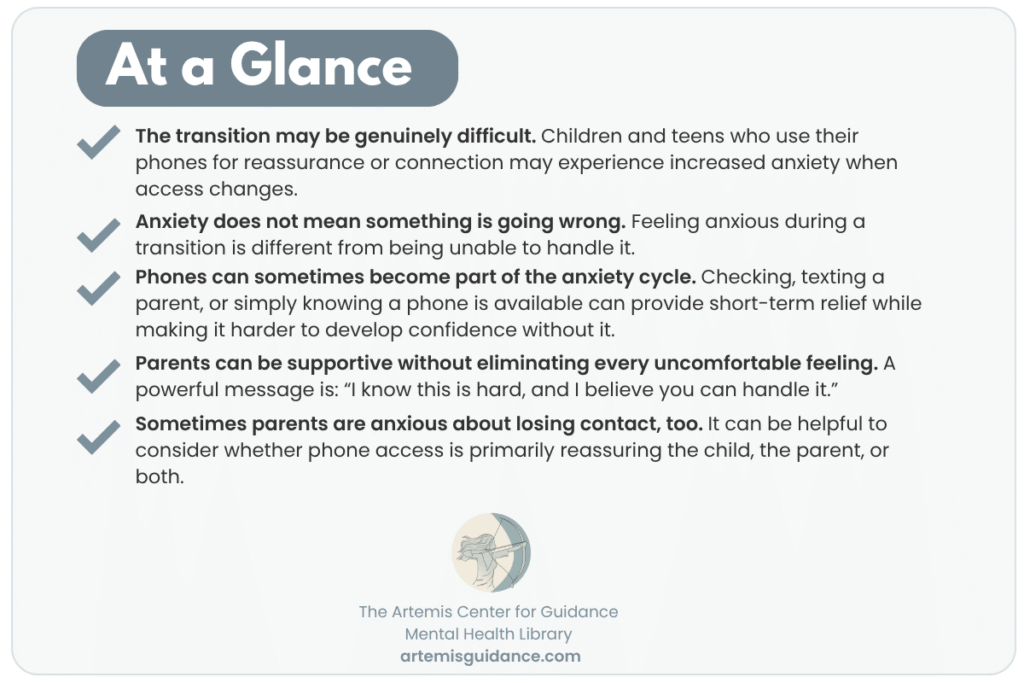
Struggling with that transition does not necessarily mean a child cannot handle it.
With thoughtful support, the adjustment may also become an opportunity for children and teens to build confidence in their ability to experience anxiety, cope with it, and continue with their day.
What Is Changing in New Jersey Schools?
Beginning with the 2026–2027 school year, New Jersey public schools are required to implement policies restricting students’ use of personal internet-enabled devices during the school day.
The New Jersey Department of Education describes this as a bell-to-bell policy. At a minimum, personal internet-enabled devices generally cannot be used by students from the beginning of the school day through dismissal, including lunch and passing periods.
Individual districts retain some flexibility in how they implement the policy, including how devices are stored and how rules are enforced.
The state’s guidance also recognizes that some students may need access to a device for an individualized reason. Exceptions include certain needs addressed through an Individualized Education Program (IEP), Section 504 plan, or student health plan, along with circumstances involving translation, caregiving responsibilities, emergencies, requirements of law, and certain situations in which no reasonable alternative to a device exists.
Families should review their own district’s policy for specific procedures.
For many parents of children with anxiety, though, the immediate concern isn’t the policy itself.
It’s:
How is my child going to manage the school day without being able to reach me?
Why a Phone-Free School Day May Feel Different for an Anxious Child
Not every student uses a phone in the same way.
For some, it’s primarily entertainment or a way to communicate with friends.
For a child with anxiety, however, a phone may sometimes serve another purpose: reassurance.
A student might text:
Are you there?
Can you pick me up if I need you?
I’m really anxious.
Are you sure everything is okay?
Sometimes the student doesn’t even need to send the message. Simply knowing that a parent is one text away can make a situation feel safer.
That means losing access to the phone can feel like much more than losing access to a device.
The child may feel as though they are losing one of the ways they know how to manage anxiety.
Understanding that can help parents respond with empathy while also becoming curious about the role the phone is playing.
When Reassurance Becomes Part of the Anxiety Cycle
Anxiety creates a powerful urge to feel better right now.
Imagine a student who becomes anxious during the school day.
They text a parent.
The parent responds.
The anxiety decreases.
Of course that feels helpful. The child was distressed and now feels better.
But the brain may also learn something from that experience:
“I felt better because I checked with my parent.”
The next time anxiety appears, the urge to check may become even stronger.
In anxiety treatment, behaviors that help someone feel safer in the moment but may unintentionally maintain anxiety over time are sometimes called safety behaviors.
The behavior itself isn’t bad, and the child isn’t doing anything wrong.
The more useful question is:
Is this strategy helping my child develop confidence, or is it teaching them that they can only handle the situation when this strategy is available?
For some children and teens, frequent access to a phone can become part of that cycle.
Anxiety Is Uncomfortable. That Doesn’t Always Mean It Is Unsafe.
This distinction can be particularly difficult when you’re watching your own child struggle.
When a child is distressed, a parent’s natural instinct is often to make the distress stop.
But effective anxiety treatment isn’t usually about making sure a person never experiences anxiety.
Instead, children can learn:
I can feel anxious and still do what matters.
I can be uncomfortable without escaping immediately.
Anxiety can rise, and it can come back down.
I can handle more than anxiety tells me I can.
These ideas are central to exposure-based treatments used for anxiety and obsessive-compulsive disorder (OCD).
Exposure does not mean forcing a child into an overwhelming situation or ignoring genuine distress. It involves helping people gradually approach situations that trigger anxiety while reducing some of the avoidance, checking, reassurance seeking, or other responses they have learned to rely upon for immediate relief.
Over time, that creates opportunities for a different kind of learning.
A child who believes:
“I can’t get through school if I can’t contact my parent”
may eventually have the experience of thinking:
“That was really uncomfortable—and I did it.”
That experience can help build confidence in a way that reassurance alone cannot.
Parents Are Part of the Anxiety System, Too
Childhood anxiety rarely happens entirely in isolation.
Parents naturally respond when their children are distressed.
You reassure them. You change plans. You help them avoid something that feels overwhelming. You make yourself available in case they need you.
Those responses usually come from exactly the right place: you want to help your child.
Sometimes, though, families can unintentionally begin organizing themselves around anxiety.
Researchers use the term family accommodation to describe ways family members change their own behavior to reduce a child’s anxiety or distress.
That might include repeatedly reassuring a child, helping them avoid feared situations, changing family routines, answering the same worry again and again, or remaining constantly available so the child does not have to tolerate uncertainty.
Accommodation can make perfect sense in the moment.
And sometimes it can become part of what keeps anxiety going.
The alternative is not becoming cold or dismissive.
A supportive parent can say:
“I know you’re anxious.”
“I understand why this feels hard.”
“We have a plan for what you can do if you’re struggling.”
And also:
“I believe you can handle this.”
Acknowledging a child’s distress while communicating confidence in their ability to cope sends a very different message from immediately removing whatever is causing the anxiety.
Sometimes the Parent Is More Anxious Than the Child
There is another possibility worth considering:
Sometimes the child isn’t the person having the hardest time with the new phone rules.
Parents have become accustomed to being able to reach their children during the school day, too.
A quick text can confirm that they arrived safely, that a difficult morning got better, or simply that everything is okay.
Losing that access can be uncomfortable.
A parent may find themselves thinking:
What if they need me?
What if something happens and they can’t reach me?
What if they’re anxious and I don’t know about it?
Those concerns are understandable. But they can also influence how we interpret a child’s need for phone access.
A child may actually be adapting reasonably well while a parent continues to feel uneasy about being unavailable to them.
In other situations, a child may become more worried about losing phone access after sensing how concerned a parent is about the change.
That is why one useful question for parents is:
Whose anxiety are we trying to manage?
There isn’t a wrong answer.
Sometimes the phone is primarily helping manage the child’s anxiety.
Sometimes it is reassuring the parent.
Often, it may be doing a little of both.
Recognizing that isn’t about blaming parents or minimizing legitimate concerns. It is about becoming curious about what the phone is doing for the family so everyone can make better decisions about what support the child actually needs.
A parent’s confidence can also become a form of support.
When a parent communicates:
“I know this might be uncomfortable, and I believe you can handle it,”
they give their child something different from immediate reassurance: confidence in the child’s own ability to cope.
Make a Plan Before the First Difficult Moment
One of the best times to talk about coping with anxiety is before anxiety is at its highest.
Instead of focusing only on what your child will no longer be able to do, talk together about what they can do when they become anxious at school.
Depending on your child’s age and individual needs, that might include:
-
- identifying a trusted adult at school;
-
- understanding where they can go if they become overwhelmed;
-
- practicing coping strategies they already use successfully;
-
- knowing how the school will contact you if necessary;
-
- understanding how your child can reach you in an appropriate situation;
-
- practicing what they can tell themselves when the urge to check or text becomes strong; or
-
- gradually reducing unnecessary reassurance-seeking before the new routine begins.
It can also help for parents to understand the school’s procedures.
If there is an emergency, how are parents and students contacted?
If a student becomes sick, what happens?
If your child needs support from a counselor or another staff member, where do they go?
Knowing the answers can reduce uncertainty for both children and parents.
The goal isn’t to develop a plan that guarantees your child will never feel anxious.
It’s to help them know:
“If anxiety shows up, I know what I can do.”
What If My Child Really Does Need Device Access?
There is an important difference between helping a child reduce anxiety-driven reliance on a phone and assuming that every student should be able to function without access to an internet-enabled device.
Some students have legitimate medical, disability-related, educational, communication, or other needs that require individualized consideration.
New Jersey’s guidance specifically recognizes exceptions in certain circumstances, including supports contained in IEPs, Section 504 plans, and student health plans.
The state’s guidance even provides examples that can involve mental health or behavioral needs, such as using a guided app to manage anxiety or communicating with a caregiver as part of a behavioral plan contained in an IEP.
Those decisions should be individualized.
Rather than beginning with:
“Should my child get a phone exception?”
it may be more useful to ask:
“What does my child need in order to participate successfully and safely in school?”
For one student, appropriate support may include access to a device.
For another, it may involve access to a counselor, a planned break, coping strategies, changes in how adults respond to reassurance seeking, or another individualized support.
The goal is not to make a blanket judgment about whether anxious children should or should not have access to phones.
It is to understand what a particular child needs and what function the support serves for that child.
When Anxiety Is Making School Hard
If your child’s anxiety is interfering with school attendance, concentration, relationships, independence, or daily functioning, it may be helpful to look beyond the phone itself.
Sometimes the phone isn’t really the problem.
It is simply where the anxiety becomes visible.
A child or teen may be struggling with separation anxiety, panic, social anxiety, OCD, generalized worry, school avoidance, trauma-related symptoms, or another concern that deserves attention.
Evidence-based treatment can help children and families understand what is maintaining anxiety and develop different ways of responding to it.
Cognitive behavioral therapy (CBT) and exposure-based approaches can help children and teens gradually develop greater tolerance for uncertainty and uncomfortable feelings.
For families in which accommodation has become a significant part of the anxiety cycle, parent-based treatment can also be useful.
One such approach is Supportive Parenting for Anxious Childhood Emotions (SPACE).
SPACE focuses on helping parents respond supportively to anxiety while gradually reducing accommodations that may unintentionally reinforce it.
In a randomized clinical trial involving children ages 7 to 14 with primary anxiety disorders, SPACE was found to be noninferior to child-focused CBT on anxiety outcomes and produced greater reductions in family accommodation.
A 2026 systematic review found emerging evidence that SPACE may reduce both child symptoms and family accommodation, while also noting limitations in the size and quality of the existing research base.
Helping Children Discover What They Can Handle
New routines can be uncomfortable.
For some children and teens with anxiety, a phone-free school day may feel like a very big change.
Parents don’t have to dismiss that feeling.
And they don’t necessarily have to eliminate it.
There is a middle ground where a parent can say:
“I understand why this is hard.”
and, at the same time:
“I believe you can learn how to handle it.”
For many children, that is where confidence begins.
Not when anxiety disappears.
But when they discover that anxiety can show up—and they can keep going anyway.
When Additional Support May Help
If anxiety is making it difficult for your child or teen to participate in school, tolerate separation, manage uncertainty, or function independently, therapy can help identify what may be maintaining the anxiety and what kinds of support may be most useful.
At The Artemis Center for Guidance, our clinicians work with children, adolescents, adults, and families experiencing anxiety, OCD, school-related concerns, and other mental health challenges.
Sources
New Jersey Department of Education. Release of Updated Guidelines on Student Use of Internet-Enabled Devices. January 28, 2026.
New Jersey Department of Education. Guidance for Schools on Student Use of Internet-Enabled Devices. 2026.
Lebowitz, E. R., et al. Parent-Based Treatment as Efficacious as Cognitive-Behavioral Therapy for Childhood Anxiety: A Randomized Noninferiority Study of Supportive Parenting for Anxious Childhood Emotions. Journal of the American Academy of Child & Adolescent Psychiatry, 2020.
Lebowitz, E. R., Scharfstein, L. A., & Jones, J. Comparing Family Accommodation in Pediatric Obsessive-Compulsive Disorder, Anxiety Disorders, and Nonanxious Children. Depression and Anxiety, 2014.
Lebowitz, E. R., Marin, C. E., & Silverman, W. K. Measuring Family Accommodation of Childhood Anxiety. Journal of Clinical Child & Adolescent Psychology, 2020.
Johnco, C., et al. The Role of Parental Beliefs About Anxiety and Attachment on Parental Accommodation of Child Anxiety. 2022.
Egan, R., Byrne, G., Hadfield, K., & Swords, L. Supportive Parenting for Anxious Childhood Emotions (SPACE) in Addressing Paediatric Psychological Difficulties and Family Accommodations: A Systematic Review. Child Psychiatry & Human Development, 2026.