

Sometimes people understand their trauma very well.
They know what happened. They may understand why certain situations bother them. They may have talked about the experience in therapy and developed a very clear understanding of how the past affected them.
And yet their body still seems to react before their mind has a chance to catch up.
A sound makes their heart race. Conflict causes their muscles to tense. Someone standing too close makes them want to move away. They freeze when they want to speak. Or instead of feeling overwhelmed, they suddenly feel numb or disconnected.
Knowing “I’m safe now” does not always immediately change those reactions.
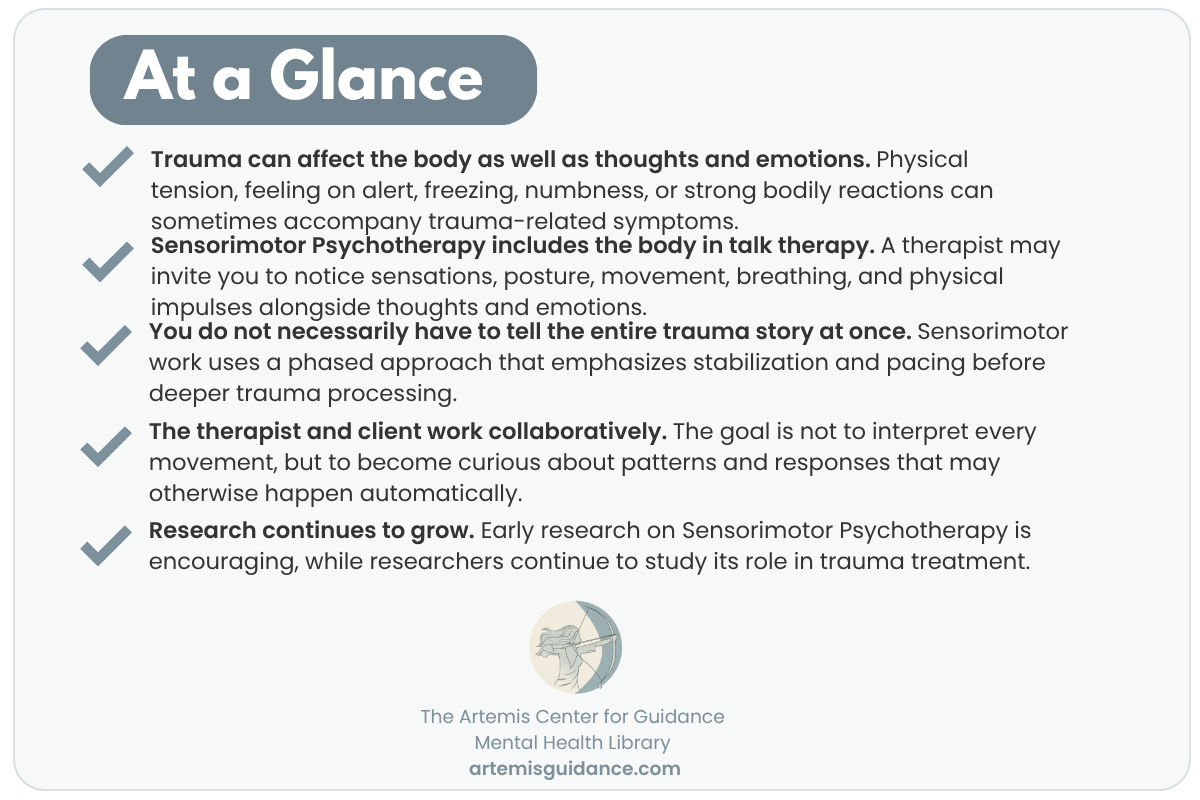
Sensorimotor Psychotherapy is one approach to trauma treatment that pays particular attention to this connection between thoughts, emotions, and physical experience.
What Is Sensorimotor Psychotherapy?
Sensorimotor Psychotherapy was developed by psychologist Pat Ogden beginning in the 1970s and 1980s. It is a body-oriented form of psychotherapy used with trauma and attachment-related concerns.[1]
Importantly, it is still psychotherapy.
You talk. You think. You explore emotions, relationships, beliefs, memories, and experiences.
But your body is also treated as a source of information.
A therapist using Sensorimotor Psychotherapy may pay attention to changes in posture, movement, muscle tension, breathing, physical sensations, or impulses to move. The client is invited to notice these experiences too.
The Sensorimotor Psychotherapy Institute describes the approach as integrating somatic—or body-based—experience with emotional and cognitive processing.[1]
You may sometimes hear this described as a “bottom-up” approach.
What Does “Bottom-Up” Therapy Mean?
Many familiar forms of therapy rely heavily on what might be called top-down processing.
You use language and thought to understand an experience. You may examine beliefs, make connections, reconsider interpretations, or learn different ways of responding.
Bottom-up work begins more deliberately with information coming from the body.
That doesn’t mean one is good and the other is bad. And it certainly doesn’t mean that thinking disappears from sensorimotor therapy.
In fact, Sensorimotor Psychotherapy intentionally brings the two together. Its training model incorporates body-oriented interventions alongside cognitive, emotional, attachment, and psychodynamic concepts.[2]
The difference is that the therapist may sometimes ask:
“What are you noticing in your body right now?”
before immediately asking:
“What do you think about that?”
How Can Trauma Show Up Physically?
The body has systems designed to respond rapidly when something appears dangerous.
You don’t have to consciously decide to make your heart beat faster when you’re frightened. You don’t have to deliberately tense your muscles before jumping out of the way of something coming toward you.
These responses can be protective.
After a traumatic experience, however, some people continue to experience strong reactions to reminders of what happened or to situations their nervous system interprets as threatening.
That might look like:
- becoming tense or physically restless
- startling easily
- feeling constantly on guard
- freezing during conflict
- feeling numb or disconnected
- noticing a strong urge to leave a situation
- having intense physical reactions to certain sounds, smells, places, or interactions
- having difficulty recognizing or describing physical sensations
- intellectually knowing that you’re safe while still feeling physically threatened
Some of these physical responses can also occur with anxiety, which can make it difficult to understand what your body is responding to.
These experiences are not unique to trauma, and having one or more of them does not automatically mean that someone has PTSD.
They are simply examples of why the body can be useful information in therapy.
What Happens During Sensorimotor Therapy?
This is often what people really want to know.
What are we actually going to do?
There isn’t one exercise that defines Sensorimotor Psychotherapy, and sessions are individualized.
You might be describing a recent disagreement, for example, and notice that your shoulders have become tense.
Instead of continuing immediately with the story, a therapist might invite you to pause.
What do you notice?
Where do you feel the tension?
Did anything change when you started talking about the disagreement?
Do you notice an impulse to move, turn away, make yourself smaller, push away, or do something else?
The purpose isn’t for the therapist to announce what your posture “means.”
It is an invitation to become curious.
Sensorimotor training includes mindfulness, tracking bodily experience, and verbal and physical experiments designed to help clients notice patterns and explore different responses.[3]
That word experiment is important.
The client and therapist are exploring together rather than the therapist deciding what the client’s body is trying to say.
Do I Have to Retell My Trauma in Detail?
Not necessarily.
One concern people sometimes have about trauma therapy is:
“Am I going to have to tell you everything that happened?”
Sensorimotor Psychotherapy uses a phase-oriented model.
The Sensorimotor Psychotherapy Institute describes three broad phases: developing safety and stabilization, processing the effects of trauma, and integration.[1][3]
These phases are not necessarily a rigid sequence. Skills and earlier phases can be revisited as needed.[4]
Early work may focus on noticing what happens in the present and developing resources for managing arousal before approaching more difficult trauma material.
During trauma processing, the approach may work with smaller pieces of memory while maintaining awareness of what is happening in the present rather than asking someone simply to relive an entire traumatic experience.[4]
That does not mean sensorimotor therapy is always comfortable.
Trauma therapy can involve difficult emotions, memories, and sensations.
But overwhelming someone is not the goal.
What Does “Resourcing” Mean?
You may hear a sensorimotor therapist use the word resource.
In everyday language, a resource is simply something useful that you can draw upon.
In Sensorimotor Psychotherapy, therapists may help clients identify or develop physical and psychological resources that support regulation and a greater sense of stability.
Sensorimotor training includes somatic resources such as grounding, centering, containment, and alignment.[3]
A resource might involve noticing the support of the chair beneath you, feeling your feet against the floor, orienting to the room around you, experimenting with posture, or identifying a movement that creates a greater sense of strength or choice.
The point is not to convince yourself that everything is fine.
It is to expand the number of ways you can respond when your system becomes activated.
What Is the “Window of Tolerance”?
The phrase window of tolerance comes up frequently in conversations about trauma therapy.
In simple terms, it describes a range of emotional and physiological activation in which someone can remain present and able to respond with some flexibility.
When activation becomes very high, a person might feel panicked, agitated, overwhelmed, or desperate to escape.
When activation moves in the other direction, a person might feel numb, shut down, disconnected, or unable to engage.
Sensorimotor Psychotherapy pays close attention to these shifts in arousal. The approach aims to help clients recognize their own patterns and develop additional ways to regulate them.[4]
The goal isn’t to remain perfectly calm all the time.
Human beings aren’t supposed to do that.
Rather, therapy can help someone notice what is happening and have more choices about what happens next.
Is Sensorimotor Therapy the Same as Somatic Therapy?
Not exactly.
Somatic therapy is a broad term. It generally refers to therapeutic approaches that intentionally include bodily experience as part of psychological treatment.
Sensorimotor Psychotherapy is one particular model within that broader landscape.
It has its own theoretical framework, training program, terminology, and interventions.
You may also hear about other body-oriented approaches, including Somatic Experiencing. These approaches may share some ideas or areas of interest, but they should not be treated as interchangeable simply because both pay attention to the body.
This matters when you’re looking for a therapist.
If someone says they provide “somatic therapy,” it is reasonable to ask what that means in their practice and what training they have received.
Does Sensorimotor Therapy Work for Trauma?
This deserves a careful answer.
There is promising research, but the evidence specifically supporting Sensorimotor Psychotherapy is still developing.
The approach has been used clinically for decades, but longevity and clinical popularity are not the same thing as scientific evidence.
Small studies of Sensorimotor-informed interventions have reported encouraging results, including improvements in trauma-related symptoms and body awareness. However, the research base remains much smaller than the evidence supporting several established PTSD treatments.[5]
Current PTSD treatment guidelines identify Prolonged Exposure (PE), Cognitive Processing Therapy (CPT), and Eye Movement Desensitization and Reprocessing (EMDR) among the trauma-focused psychotherapies with the strongest research support.[6]
That doesn’t mean Sensorimotor Psychotherapy cannot be helpful.
It means we should describe the evidence accurately.
Promising is not the same as proven, and “body-based” does not automatically mean better than other forms of trauma treatment.
People deserve enough information to make informed choices about their care.
Is Sensorimotor Therapy Right for Everyone With Trauma?
No single trauma treatment is right for every person.
Someone might be particularly interested in sensorimotor work if they notice that their difficulties seem to involve strong physical responses.
They might say:
“I understand why I react this way, but my body still reacts.”
Or:
“I know I’m safe, but I don’t feel safe.”
Someone who has spent considerable time understanding their experiences through traditional talk therapy may also be curious about an approach that deliberately includes physical experience.
But treatment decisions should consider much more than whether an approach sounds appealing.
Symptoms, diagnosis, trauma history, current safety, other mental or physical health concerns, previous treatment, personal preferences, and therapeutic goals can all matter.
If you are considering trauma therapy, it is reasonable to ask a therapist:
- What training have you received in trauma treatment?
- What approach or approaches do you use?
- What does a typical session look like?
- How do you decide when someone is ready to process traumatic memories?
- What happens if I become overwhelmed or shut down?
- What evidence supports the treatment you’re recommending?
- How will we know whether therapy is helping?
A good therapy conversation can include questions about the therapy itself.
If you’re new to therapy, knowing what to expect at a first therapy appointment can make starting feel a little less uncertain.
Trauma Is More Than the Story of What Happened
Trauma can affect memories, thoughts, emotions, beliefs, relationships, and physical responses.
For some people, understanding the story is an important part of healing.
For others, insight alone may not seem to change the moment when their shoulders tighten, their heart begins racing, their body freezes, or they suddenly feel far away.
Sensorimotor Psychotherapy offers one way of becoming curious about those experiences rather than treating them as separate from psychological health.
The aim isn’t to force the body to forget what happened.
It is to notice what is happening in the present—and gradually develop more awareness, flexibility, and choice in how you respond.
Sources
[1] Sensorimotor Psychotherapy Institute. What Is Sensorimotor Psychotherapy? Describes Sensorimotor Psychotherapy, its development by Pat Ogden, integration of somatic, emotional and cognitive processing, and its phase-oriented approach.
[2] Sensorimotor Psychotherapy Institute. Curriculum. Describes the integration of body-oriented psychotherapy with psychodynamic, cognitive-behavioral, attachment, dissociation, and other psychological frameworks.
[3] Sensorimotor Psychotherapy Institute. Level I: SP for the Treatment of Trauma. Describes training in mindfulness, somatic resources, tracking activation, trauma processing, and integration.
[4] Sensorimotor Psychotherapy Institute. Sensorimotor Psychotherapy Client Education and Resources. Describes typical sessions, phase-oriented treatment, present-moment awareness, dual awareness, resourcing, and trauma processing.
[5] Sensorimotor Psychotherapy Institute. Research Resources. Includes published research on body-oriented group psychotherapy adapted from Sensorimotor Psychotherapy and other research related to the approach.
[6] U.S. Department of Veterans Affairs, National Center for PTSD. Overview of Psychotherapy for PTSD. Summarizes the 2023 VA/DoD guideline and the evidence supporting trauma-focused PTSD treatments, including PE, CPT, and EMDR.