

Have you ever canceled plans because you felt anxious, only to feel immediate relief once you decided not to go?
Maybe you avoided a difficult conversation, put off making a phone call, or asked someone to reassure you that everything would be okay.
For a little while, you felt better.
But the next time you faced the same situation, the anxiety was still there. It might even have felt stronger.
This is one of the frustrating things about anxiety: what helps us feel better in the moment does not always help us feel better in the long run.
Avoidance is a natural response to fear. Sometimes it is necessary and protective. But when we repeatedly avoid situations that are uncomfortable rather than genuinely dangerous, we may unintentionally give anxiety more control over our lives.
Understanding this pattern is an important step toward changing it.
If you’re wondering whether anxiety can improve over time, our article Can Anxiety Go Away? explores what meaningful recovery can look like.
What Is the Anxiety Avoidance Cycle?
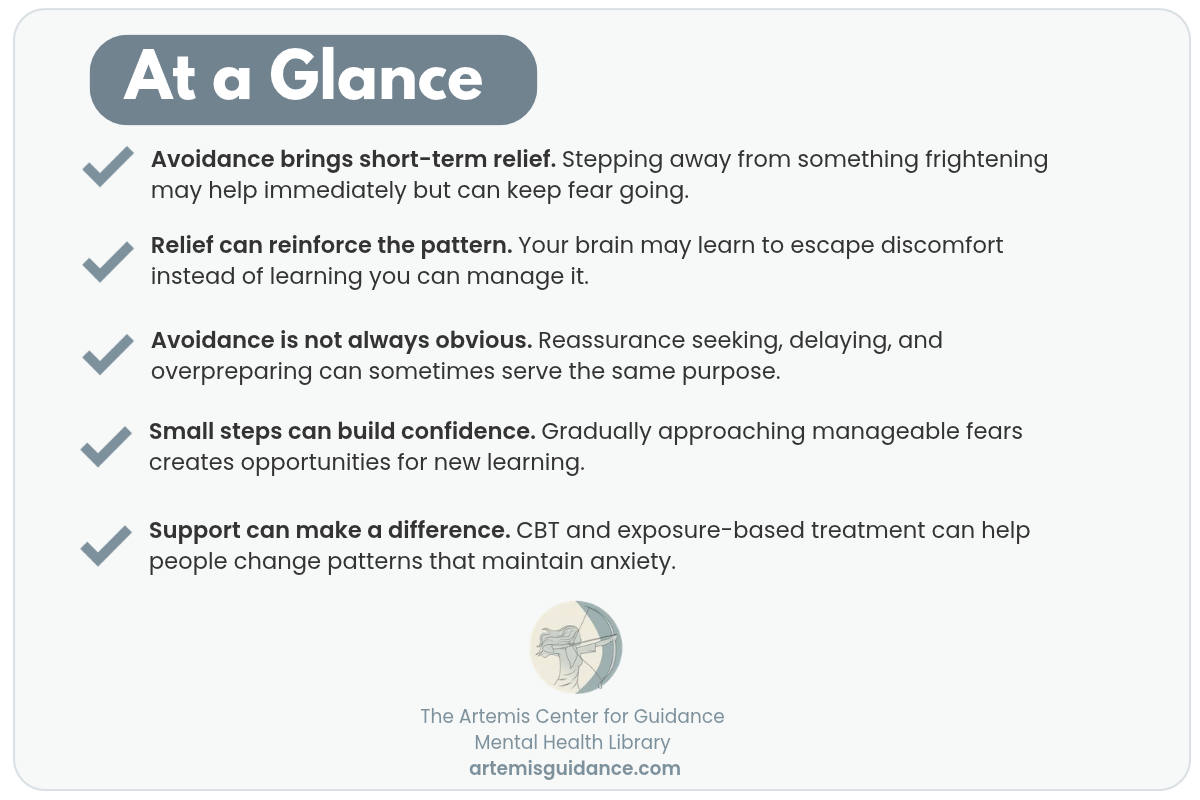
The anxiety avoidance cycle describes a pattern in which fear leads us to avoid something, avoidance brings temporary relief, and that relief makes us more likely to avoid the same thing again.
Imagine someone who becomes anxious about driving on the highway.
They worry about having a panic attack while driving. Their heart begins to race when they think about getting onto the highway.
Instead of driving, they take a longer route using local roads.
Their anxiety decreases almost immediately.
That relief feels good. It may also reinforce the belief that avoiding the highway was what kept them safe.
The next time they need to drive somewhere, the highway may feel just as frightening—or more so.
The cycle looks something like this:
- A situation triggers anxiety. You imagine something uncomfortable or frightening happening.
- You avoid the situation. You cancel, delay, leave, or find another way around it.
- You experience relief. Your anxiety decreases because you no longer have to face the situation.
- Avoidance becomes more appealing. Your brain learns that escaping discomfort brings relief.
- The fear remains. You miss an opportunity to discover what you might have been able to handle.
Over time, this pattern can make everyday activities feel increasingly difficult.
The National Health Service explains that avoiding feared situations can provide short-term relief while making those situations harder to face in the future (NHS, 2022).
Why Does Avoidance Make Anxiety Worse?
To understand why avoidance can maintain anxiety, it helps to consider how we learn from experience.
When something frightens us, our brain naturally pays attention. It wants to protect us from danger.
If we escape the situation and immediately feel better, our brain may connect that relief with leaving.
In psychology, this is called negative reinforcement. It does not mean punishment or doing something wrong. It means that removing an unpleasant feeling makes a behavior more likely to happen again.
Avoidance can become a habit because it works so well at reducing anxiety in the moment.
The difficulty is that leaving also prevents us from learning something new.
For example, someone who avoids speaking in meetings may never discover that they can feel nervous, share an idea, and still have a productive conversation.
Someone who repeatedly cancels social plans may not have opportunities to learn that awkward moments are manageable and that connection is possible even when they feel uncomfortable.
Avoidance protects us from the feeling we fear, but it can also keep us from discovering what we are capable of handling.
This does not mean every fear is unreasonable. Real dangers exist, and avoiding harmful situations is often appropriate. The concern is when anxiety causes us to treat manageable discomfort or uncertainty as though it were a serious threat.
What Does Anxiety Avoidance Look Like in Everyday Life?
Avoidance is not always as obvious as refusing to do something.
Sometimes it appears as a habit that looks responsible, careful, or even helpful.
Avoiding Situations
This is the most recognizable form of avoidance.
Examples include:
- Declining invitations because social situations feel uncomfortable.
- Avoiding driving, flying, or public transportation.
- Putting off medical appointments because of fear.
- Staying away from places associated with previous panic attacks.
- Avoiding difficult conversations.
- Missing school or work because of anxiety.
These choices may bring relief, but repeated avoidance can gradually make life smaller.
Seeking Reassurance Repeatedly
Asking for reassurance is a normal part of being human. We all need support sometimes.
But reassurance can become part of the anxiety avoidance cycle when someone repeatedly asks the same question because they cannot tolerate uncertainty.
For example:
- “Are you sure you’re not upset with me?”
- “Do you think this symptom means something serious?”
- “Are you positive nothing bad will happen?”
- “Can you check one more time?”
The answer may help for a few minutes. Then another doubt appears.
When reassurance becomes the main way someone manages anxiety, it can become difficult to trust their own ability to cope with uncertainty.
Overpreparing or Delaying
Sometimes avoidance looks like preparing endlessly for something we never quite begin.
Someone might spend hours researching a decision because they fear making the wrong choice.
Another person might rewrite an email repeatedly because they worry about being misunderstood.
Preparation can be useful. But when its main purpose is to prevent every possible mistake or uncomfortable feeling, it can become another way of avoiding uncertainty.
Using Safety Behaviors
Safety behaviors are actions people use to feel protected from a feared outcome.
Someone with social anxiety might rehearse every sentence before speaking. A person worried about panic might constantly monitor their heartbeat.
Not all coping tools are safety behaviors, and not all safety behaviors are harmful. The important question is whether a habit supports meaningful participation or reinforces the belief that a situation cannot be managed without it.
How Can You Tell the Difference Between Healthy Boundaries and Avoidance?
This distinction matters.
Not every decision to step away from something uncomfortable is anxiety avoidance.
Sometimes declining an invitation means respecting your energy. Sometimes leaving a situation means protecting yourself. Sometimes postponing a conversation allows you to approach it more thoughtfully.
You do not need to push yourself through every difficult experience to prove that you can manage anxiety.
A useful question is:
Am I making this choice because it reflects my needs and values, or mainly because I want to escape the feeling of anxiety?
You might also ask:
- Is this situation actually unsafe, or does it feel uncomfortable?
- Is avoiding it helping me care for myself, or limiting something important to me?
- Does this choice bring lasting relief, or does the same fear keep returning?
- If anxiety were less intense, would I want to make a different choice?
There is no single answer that applies to every situation.
The goal is not to eliminate boundaries or ignore warning signs. It is to recognize when fear may be making decisions that you would otherwise make differently.
How Do You Break the Anxiety Avoidance Cycle?
Changing avoidance patterns does not require suddenly confronting your greatest fear.
In fact, taking manageable steps is often more useful than pushing yourself too far, too quickly.
1. Notice What You Are Avoiding
Start by paying attention to situations you regularly delay, escape, or work around.
Notice what happens just before you decide to avoid them.
What are you afraid might happen?
Are you worried about embarrassment, losing control, making a mistake, disappointing someone, or feeling overwhelmed?
Identifying the feared outcome can help you understand what is driving the behavior.
2. Notice What Happens Afterward
Pay attention to the relief you experience when you avoid something.
You do not need to judge yourself for feeling relieved.
Instead, ask whether the relief lasts.
Does avoiding the situation make the next attempt easier, or does the fear return?
Recognizing this pattern can help you distinguish between short-term comfort and longer-term change.
3. Choose a Small, Manageable Step
Rather than trying to tackle everything at once, identify one action that feels challenging but possible.
If you have been avoiding social situations, that might mean having a brief conversation with a coworker rather than attending a large gathering.
If you have been putting off a phone call, it might mean making one routine call without rehearsing every possible response.
If you struggle with uncertainty, it might mean making a low-stakes decision without repeatedly asking others to confirm it.
The NHS recommends approaching fears gradually, beginning with situations that feel more manageable and building from there (NHS, 2022).
4. Allow Some Discomfort Without Immediately Escaping
When you approach something you fear, anxiety may increase at first.
That does not automatically mean you are doing something wrong.
The aim is not necessarily to make anxiety disappear immediately. It is to learn that uncomfortable feelings can sometimes be experienced without needing to escape them.
You might notice your heart beating faster, feel uncertain about what to say, or worry that something will go wrong.
Where the situation is reasonably safe, you can practice allowing those feelings to be present while continuing with what matters to you.
Progress may mean doing something while anxious, not waiting until you feel completely calm.
5. Pay Attention to What You Learn
After taking a step, consider what actually happened.
Did the outcome match what you feared?
If something uncomfortable happened, were you able to manage it?
Did you discover that you could tolerate uncertainty longer than expected?
Sometimes the feared outcome does happen. A conversation may be awkward. Someone may disagree with you. You may feel anxious throughout an activity.
That does not mean the effort failed.
Learning that you can respond to difficulty is valuable, even when an experience is not perfectly comfortable.
What Is Exposure-Based Therapy?
Exposure-based therapy is a structured approach that helps people change their responses to situations, thoughts, or sensations they fear.
You can learn more about exposure-based CBT and the concerns it may help address.
It is often used as part of cognitive behavioral therapy (CBT), which examines the relationships among thoughts, feelings, physical sensations, and behaviors.
Exposure-based treatment may involve gradually approaching feared situations while reducing patterns of avoidance or other behaviors that maintain anxiety.
For example, someone with a specific phobia might work with a therapist to develop a series of manageable steps related to that fear.
Someone experiencing panic might learn to respond differently to certain physical sensations.
For obsessive-compulsive disorder (OCD), a related treatment called exposure and response prevention (ERP) helps people practice facing triggers without relying on compulsive responses.
These approaches are not identical, and treatment should be matched to the person’s needs.
Clinical guidelines recommend CBT for several anxiety disorders, including generalized anxiety disorder and panic disorder (NICE, 2011).
Exposure-based treatment is not about forcing people into frightening experiences or promising that nothing bad will ever happen.
It is about creating opportunities for new learning in a thoughtful, collaborative way.
For people with severe anxiety, OCD, trauma-related symptoms, or complex medical concerns, exposure exercises should be developed with an appropriately trained professional rather than attempted without guidance.
What If Avoidance Is Affecting Your Child or Teen?
Children and teenagers may also avoid situations that make them anxious.
This might look like refusing to attend school, avoiding activities they previously enjoyed, asking for repeated reassurance, or needing a parent nearby to feel safe.
A child’s avoidance is not necessarily defiance or a lack of motivation.
It may reflect genuine distress.
Parents understandably want to protect their children from uncomfortable feelings. Sometimes that means allowing a child to skip an activity or stepping in to prevent distress.
While support and flexibility are important, repeatedly removing every anxiety-provoking situation can sometimes make it harder for a child to build confidence.
The goal is not to dismiss a child’s fears or force them into situations they are not ready to manage.
Instead, adults can acknowledge the feeling, understand the source of the fear, and help the child take developmentally appropriate steps.
When anxiety significantly interferes with school, friendships, sleep, or family life, a child mental health professional can help determine what support may be useful.
When Is It Time to Seek Help?
Occasional avoidance is common.
But professional support may be helpful when anxiety begins to interfere with daily life or when the number of situations you avoid continues to grow.
You might notice that:
- Your world is becoming smaller because of fear.
- You are missing activities, opportunities, or relationships that matter to you.
- You need frequent reassurance to get through everyday decisions.
- You spend significant time planning around possible anxiety.
- You feel trapped between wanting to do something and fearing how you will feel.
- Attempts to change the pattern on your own have been difficult.
A therapist can help identify what is maintaining anxiety and determine whether CBT, exposure-based treatment, or another approach may be appropriate.
Treatment should take your circumstances, safety, preferences, and goals into account.
You Can Move Forward Without Feeling Completely Ready
Avoidance often begins as an attempt to protect ourselves.
When anxiety feels intense, choosing relief makes sense. There is no reason to judge yourself for developing habits that helped you get through difficult moments.
But a habit that once felt protective may eventually begin limiting your life.
Changing that pattern does not require becoming fearless.
It may begin with recognizing one moment when anxiety asks you to step away—and considering whether there is a small, safe way to move toward something important instead.
Confidence does not always come before action.
Sometimes it grows through the experience of doing something difficult, discovering what you can manage, and realizing that anxiety does not have to make every decision.
References
National Health Service (NHS). (2022). Facing your fears. Every Mind Matters.
https://www.nhs.uk/every-mind-matters/mental-wellbeing-tips/self-help-cbt-techniques/facing-your-fears/
National Institute for Health and Care Excellence (NICE). (2011). Generalised anxiety disorder and panic disorder in adults: management (CG113).
https://www.nice.org.uk/guidance/cg113/chapter/Recommendations

