
For many families, the start of a new school year brings excitement. New teachers, fresh notebooks, and the return of familiar routines can all be positive changes.
For others, however, the transition back to school can bring significant anxiety.
Some children become unusually quiet. Others complain of stomachaches or headaches. Teenagers who normally seem confident may suddenly become irritable, withdrawn, or reluctant to return to school.
These reactions are often a normal response to change. Understanding what your child is experiencing—and responding with patience and support—can make the transition much smoother.
What Is Back-to-School Anxiety?
Back-to-school anxiety refers to feelings of worry, nervousness, or fear related to returning to school after a break.
Some children worry about academic expectations.
Others are concerned about friendships, bullying, social situations, or simply adjusting to a different routine.
Even children who generally enjoy school can feel anxious as summer comes to an end.
What Might Anxiety Look Like?
Children don’t always say, “I’m anxious.”
Instead, anxiety often shows up in other ways.
You might notice:
Physical complaints
- Stomachaches
- Headaches
- Trouble sleeping
- Changes in appetite
- Fatigue
Emotional changes
- Increased irritability
- Tearfulness
- Clinginess
- Worrying about “what if” situations
- Feeling overwhelmed
Behavioral changes
- Refusing to talk about school
- Avoiding school-related activities
- Difficulty separating from parents
- Increased conflict at home
- Procrastinating on school preparation
Teenagers may be less likely to express fear directly. Instead, they might appear withdrawn, frustrated, or unusually emotional.
Why Does the Start of School Feel So Stressful?
School represents more than academics.
Children are returning to:
- Social expectations
- Academic demands
- Structured schedules
- Performance pressures
- New teachers
- New classmates
- Extracurricular activities
For some students, these changes feel exciting.
For others, they can feel overwhelming.
This is especially true for children who have experienced bullying, learning difficulties, ADHD, anxiety disorders, autism spectrum disorder, or other challenges. Even positive changes—such as starting middle school or high school—can bring uncertainty.
How Parents Can Help
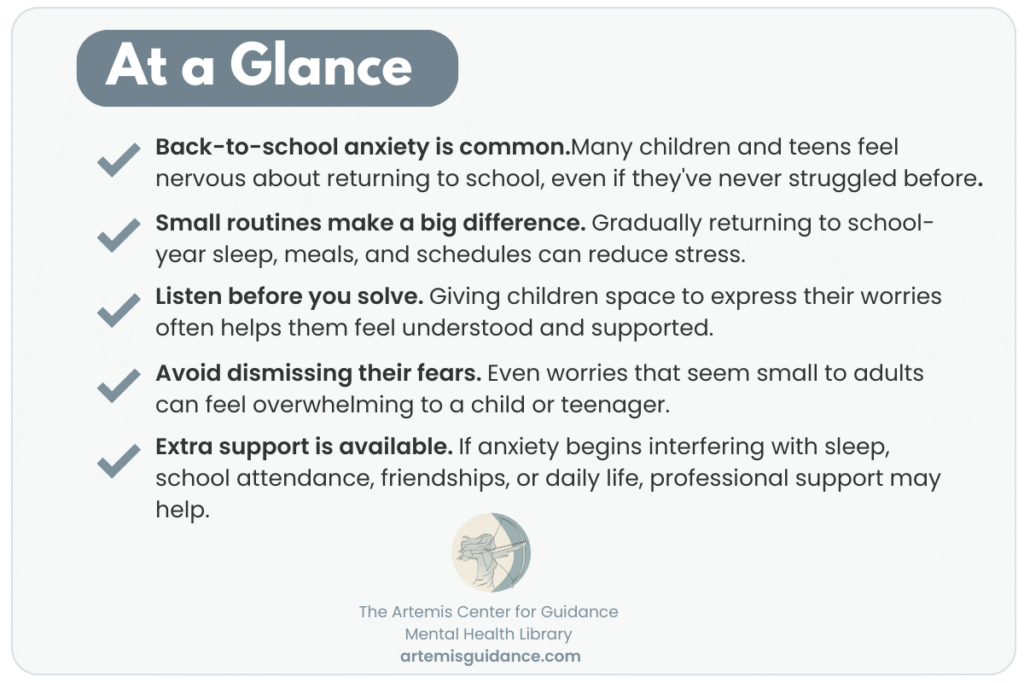
Listen first.
When children share worries, our instinct is often to reassure them immediately.
Instead of saying:
“You’ll be fine.”
Try:
“Tell me more about what’s worrying you.”
Feeling heard often reduces anxiety more than having the problem solved right away.
Return to routines gradually.
A sudden shift from summer freedom to early mornings can make the transition harder.
A week or two before school starts, begin adjusting:
- Bedtimes
- Wake-up times
- Meal schedules
- Screen time
- Daily routines
Predictability helps children feel more secure.
Validate their feelings.
You don’t have to agree that something is scary in order to acknowledge that it feels scary.
You might say:
“I can see why that feels stressful.”
“A lot of kids feel nervous before school starts.”
Validation helps children feel understood rather than dismissed.
Focus on what they can control.
Anxiety often grows when we focus on uncertainty.
Help your child think about the things they can control, such as:
- Packing their backpack
- Picking out clothes
- Practicing their morning routine
- Planning lunch
- Organizing school supplies
Small successes build confidence.
Model calm.
Children often look to adults to determine whether a situation is safe.
If parents communicate confidence, patience, and flexibility, children are more likely to feel secure.
When Is It More Than Typical Nervousness?
Some anxiety is expected.
However, it may be helpful to seek additional support if anxiety begins to:
- Prevent your child from attending school
- Cause frequent panic attacks
- Significantly interfere with sleep
- Lead to ongoing physical complaints without a medical explanation
- Affect friendships or family relationships
- Persist well beyond the first few weeks of school
Early support can often prevent anxiety from becoming more disruptive over time.
Therapy Can Help
Therapy doesn’t make school stress disappear.
Instead, it helps children and teens understand what they’re feeling, develop healthy coping skills, build confidence, and learn practical ways to manage anxiety both at school and at home.
Parents are often an important part of this process, working together with the therapist to support progress outside of sessions.
A Final Thought
The beginning of a school year is a transition—for children, teenagers, and parents alike.
A little nervousness doesn’t mean something is wrong. In many cases, it simply reflects that your child is facing something new or important.
With patience, predictable routines, and supportive conversations, many children settle into the school year successfully. And when anxiety feels bigger than your family can manage alone, reaching out for help is a sign of strength, not failure.
When you’re ready, we’re here.
If you’re considering therapy for your child, teenager, or yourself, our team at The Artemis Center for Guidance, LLC is here to answer your questions and help you decide what feels right for your family.