

Finding a therapist you trust can take time.
Maybe you’ve spent months—or years—talking with someone who knows your history. They understand the people in your life without needing an explanation. They recognize your patterns. They may know when you’re avoiding something, when you’ve made progress, and when something is harder for you than you’re letting on.
Then you learn that your therapist is leaving.
Maybe they’re changing jobs, retiring, relocating, taking an extended leave, or no longer accepting your insurance. Sometimes the change happens with plenty of notice. Sometimes it doesn’t.
Whatever the circumstances, you may find yourself thinking:
I don’t want another therapist. I want my therapist.
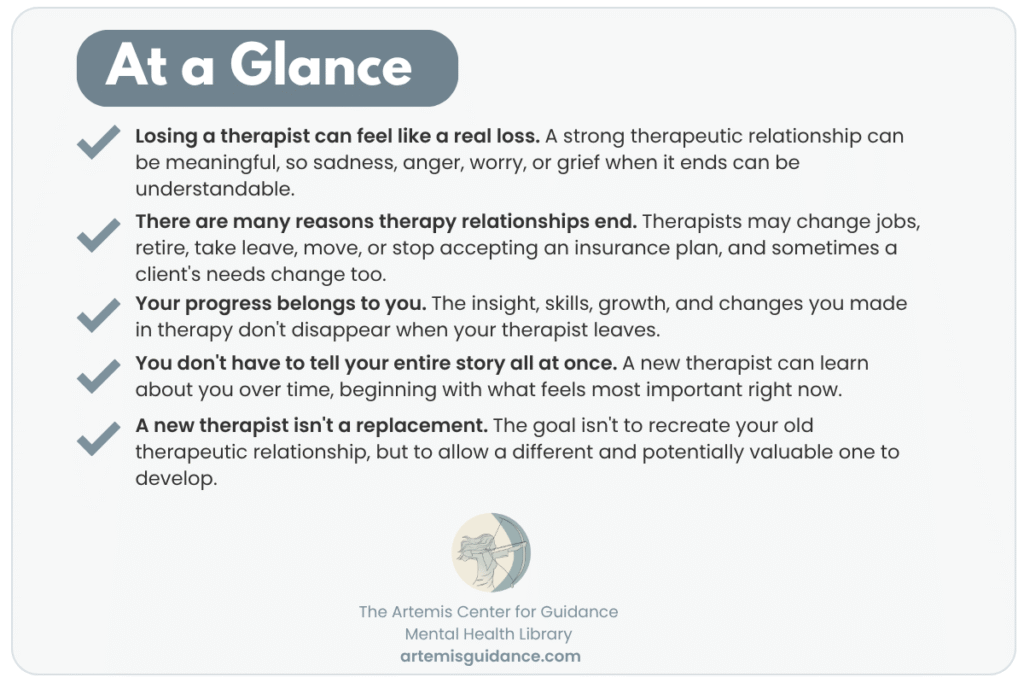
If that’s how you feel, you aren’t being unreasonable. The end of a meaningful therapeutic relationship can be a genuine loss.
It can also be the beginning of another useful chapter in therapy—even if you’re not ready to see it that way yet.
Why Can Losing a Therapist Hurt So Much?
Therapy is a professional relationship, but that doesn’t mean it isn’t a meaningful human relationship.
Over time, you may have shared experiences, fears, thoughts, or feelings that very few other people know about. You may have learned that you could be vulnerable without being judged. Your therapist may have supported you through some of the hardest periods of your life.
Trust like that usually doesn’t happen instantly. It develops over time.
So when the relationship ends, particularly when the ending wasn’t your choice, there can be a real sense of loss.
Some people feel sad. Others feel angry, rejected, worried, or abandoned. You might be frustrated that you invested so much time in developing trust only to have to do it again.
You may also feel relatively okay about the transition—or even ready for a change.
There isn’t one “correct” emotional response to losing a therapist.
Is It Normal to Grieve When Your Therapist Leaves?
It can be.
Grief isn’t limited to death. People can experience grief when an important relationship, role, routine, or period of life ends.
The therapeutic relationship is also unusual. Unlike most relationships, it exists primarily to support one person’s needs. Your therapist may know a great deal about you while you know relatively little about them.
When that relationship ends, you aren’t necessarily losing a friend, but you are losing a relationship that may have become an important and reliable part of your life.
It is possible to understand intellectually why your therapist needs to leave and still be sad that they’re leaving.
Those two things can exist at the same time.
Why Might Someone Need a New Therapist?
Therapist transitions happen for many reasons, and they aren’t always related to the quality of the therapy.
A therapist might:
- Change practices or jobs
- Move to another state
- Retire
- Take parental, medical, or another extended leave
- Change their schedule
- Stop accepting a particular insurance plan
- Change the type of clinical work they provide
Sometimes the change happens on the client’s side instead. Your insurance may change. You might move. Your availability might no longer match your therapist’s schedule.
And sometimes changing therapists is a clinical decision.
Perhaps you’ve made progress but now need a therapist with expertise in something different. Maybe treatment has stalled. Perhaps you and your therapist recognize that another approach could be helpful.
Sometimes the therapeutic relationship simply isn’t the right fit.
Whatever the reason, needing a different therapist doesn’t erase the work that came before.
“I Don’t Want to Start All Over Again”
This may be one of the hardest parts of changing therapists.
You might imagine sitting down with someone new and having to explain your childhood, family, relationships, symptoms, diagnoses, medications, major life events, and every important thing that’s happened since.
That sounds exhausting because it would be exhausting.
Fortunately, good therapy doesn’t require you to tell your entire life story during the first appointment.
You don’t have to begin at the beginning.
A new therapist will need some background information, but the two of you can decide what is most important to understand now.
You might begin by saying:
“I worked with my previous therapist for three years. We did a lot of work around anxiety and my relationship with my family. What’s bothering me most right now is…”
That’s already useful information.
When appropriate and with your permission, there may also be opportunities for communication between your previous and new providers or for relevant treatment information to be shared. What is possible will depend on the circumstances and applicable privacy requirements.
But even without that, you don’t need to recreate years of therapy in an hour.
Your new therapist can get to know you the same way your previous therapist did:
over time.
You Are Not Actually Starting Over
This is perhaps the most important thing to remember.
When a therapeutic relationship ends, the progress you’ve made doesn’t leave with the therapist.
If therapy helped you recognize patterns in your relationships, that understanding is yours.
If you learned how to respond differently when you’re anxious, you still have that ability.
If you’ve developed better boundaries, learned to recognize your emotions, practiced tolerating discomfort, understood something important about yourself, or made meaningful changes in your life, those things belong to you.
A new therapist isn’t meeting the person who walked into your first therapy appointment years ago.
They’re meeting you now, with everything you’ve learned and experienced since then.
Changing therapists can mean beginning a new therapeutic relationship.
It does not necessarily mean beginning your therapeutic work again from zero.
What If I Don’t Like the New Therapist as Much?
You might not.
At least not immediately.
A long-term therapist has an enormous advantage over someone you’ve met twice: history.
Your former therapist may have known exactly what you meant when you mentioned someone’s first name. A new therapist may need to ask, “Who’s that?”
Your old therapist may have recognized a familiar pattern immediately. Your new therapist is still learning what your patterns are.
That difference can initially feel like a step backward.
Try not to compare a brand-new therapeutic relationship with one that took months or years to develop.
Instead, consider different questions:
- Do I feel respected?
- Does this therapist listen to me?
- Can I ask questions or disagree?
- Does their approach make sense to me?
- Do they seem interested in understanding what has and hasn’t worked for me?
- Do I feel reasonably safe being honest here?
You don’t need to feel an instant bond.
Trust can grow.
Your New Therapist Doesn’t Have to Replace Your Old One
When someone has had a particularly meaningful relationship with a therapist, there can be pressure on the next therapist to be just like them.
But therapists are different people.
One may be quieter. Another may ask more questions. One may use humor frequently; another may be more structured. Different therapists have different training, personalities, perspectives, and clinical strengths.
Different doesn’t automatically mean worse.
A new therapist may notice something your previous therapist didn’t. They may explain an idea in a way that suddenly makes sense to you. Their approach may challenge you differently.
You don’t have to diminish what your former therapist meant to you in order to develop a meaningful relationship with someone else.
There is room for both.
What Can Help With the Transition?
If you know in advance that your therapeutic relationship will be ending, talk about it.
It can be tempting to avoid the subject—especially when discussing the ending makes it feel more real. But the final phase of therapy can be valuable.
You might talk about what you’ve accomplished together, what you’re still working on, what approaches have been most helpful, and what you would want a future therapist to understand.
If you’ve already begun with someone new, tell them that the transition is difficult.
You can even tell them what you miss.
For example:
“My previous therapist was very direct with me, and that helped.”
Or:
“It took me a long time to trust my last therapist, so I’m worried about having to do that again.”
That’s not insulting to your new therapist.
It’s useful clinical information.
It helps them understand what has worked for you and what you may need while developing this new relationship.
What If I Don’t Want Another Therapist?
You may need some time.
For some people, immediately scheduling with another therapist feels reassuring. Others don’t feel ready to meet somebody new right away.
If you’re considering taking a break, think about what support you currently need.
If you’re in the middle of significant symptoms, a crisis, major life changes, or treatment that requires continuity, maintaining care may be particularly important. Talk with your current therapist, new provider, or another appropriate healthcare professional about the safest plan for your circumstances.
If your situation allows for more flexibility, it may be reasonable to acknowledge that you’re reluctant.
But try to distinguish between “I’m not ready today” and “I will never let myself trust another therapist because losing this one hurt.”
Protecting yourself from another ending can also keep you from experiencing another helpful relationship.
Sometimes a Change Can Be Valuable
No one needs to pretend that an unwanted transition is secretly wonderful.
Sometimes it simply hurts.
But a change in therapists can eventually offer something valuable too.
Therapy is influenced by the relationship between therapist and client, and a different clinician brings a different perspective. A new therapist may ask questions no one has asked before or have expertise that becomes useful during your next stage of treatment.
That doesn’t mean the previous therapy failed.
It can mean your needs—and your life—continue to evolve.
Moving Forward Without Erasing What Came Before
If you are grieving the loss of a therapist, you don’t need to rush yourself into feeling grateful for the transition.
You can miss someone who helped you.
You can be frustrated that you have to explain things again.
You can wish circumstances were different.
And you can still move forward.
Perhaps the most important thing to carry with you is this:
You are not starting over.
Your therapist participated in the work, but you did the work too.
You showed up. You talked about difficult things. You practiced new ways of responding. You developed insight. You made changes. You built the ability to trust another person enough to let therapy work.
Those things don’t disappear when a therapist leaves.
A new therapist enters a story that is already in progress.
Give yourself permission to miss the relationship that ended—and, when you’re ready, give someone new the opportunity to know the person you’ve become.
When you’re ready, we’re here.
Starting with a new therapist can feel difficult, especially after a therapeutic relationship that mattered to you has ended. If you’re considering therapy for yourself or someone you love, our team is here to help you find a clinician who may be a good fit.