

People often wait a surprisingly long time before asking for help with their mental health.
They tell themselves they should be able to handle it. They compare their struggles to someone else’s. They wait for work to calm down, for the school year to get easier, for the relationship to improve, or for the feeling to pass.
And sometimes there is another thought underneath all of those:
It’s not bad enough yet.
We often talk about mental health when someone is already in crisis. Crisis services are essential, and knowing how to access them matters. But mental health care is not only for emergencies.
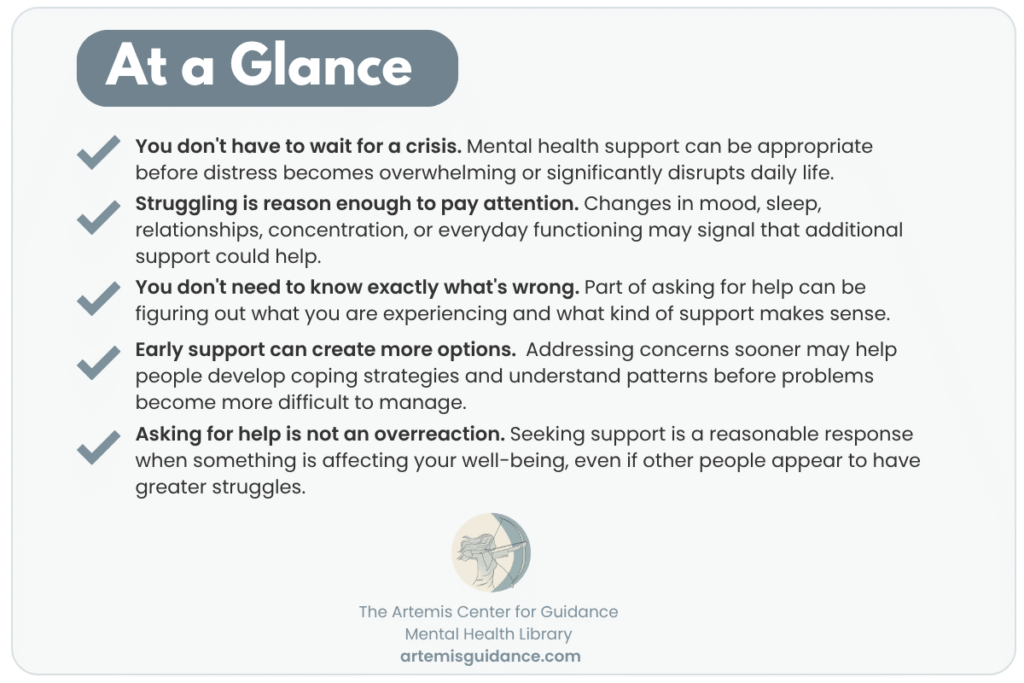
You don’t have to wait for a crisis to ask for help.
Mental Health Struggles Don’t Have to Reach a Certain Level to “Count”
It can be difficult to judge our own distress.
Someone may think:
I’m still going to work, so I must be okay.
My child is still getting good grades.
Other people have it much worse.
I’m not suicidal.
I can still get through the day.
All of those things may be true. They do not necessarily mean that everything is fine.
Mental health exists on a continuum. There is a great deal of space between feeling well and experiencing an emergency.
A person can be functioning outwardly while also feeling anxious, exhausted, disconnected, overwhelmed, irritable, sad, or unlike themselves.
You do not need to prove that you are suffering enough to deserve support.
What Does “Ask for Help” Actually Mean?
Asking for help does not always mean beginning weekly therapy.
Sometimes it means telling someone you trust that things have been difficult.
It might mean making an appointment with your primary care provider because your sleep, appetite, concentration, energy, or mood has changed.
It may mean talking with a school counselor about a child who seems overwhelmed, contacting a therapist for an evaluation, joining a support group, or asking family members for practical help during a difficult period.
The appropriate kind of support depends on what is happening.
And importantly, you do not have to know exactly what is wrong before you ask for help.
People sometimes postpone seeking support because they cannot explain what they are experiencing.
“I don’t know if this is anxiety.”
“I don’t know why I’m so tired.”
“Nothing terrible happened, so I don’t understand why I feel this way.”
“I don’t even know what I would say to a therapist.”
Figuring that out can be part of the process.
Signs It May Be Time to Pay Attention
There is no single checklist that can determine whether someone needs mental health care. Context matters, and people respond differently to stress and difficult experiences.
However, certain changes may be worth noticing, especially when they persist or begin affecting everyday life.
These might include:
- Feeling anxious, sad, angry, numb, or overwhelmed more often than usual
- Changes in sleep or appetite
- Difficulty concentrating or making decisions
- Withdrawing from friends, family, hobbies, or activities
- Increasing conflict in important relationships
- Struggling to keep up with work, school, household responsibilities, or self-care
- Feeling constantly on edge or unable to relax
- Using alcohol, substances, food, shopping, gambling, or other behaviors increasingly to cope
- Experiencing physical symptoms that may be connected to stress or anxiety
- Feeling that you are getting through each day rather than actually participating in your life
None of these automatically means that someone has a mental health disorder.
They are signals worth paying attention to.
Physical health conditions, medications, hormonal changes, sleep problems, substance use, and other medical issues can also affect mood, energy, concentration, and behavior. When symptoms are new, significant, or unexplained, medical evaluation may be appropriate as well.
“But I Can Still Function”
This is one of the most common reasons people minimize what they are experiencing.
Functioning matters, but it is not the only measure of mental health.
Someone can arrive at work every morning while experiencing significant anxiety.
A teenager can earn excellent grades while feeling miserable.
A parent can take care of everyone else while barely holding themselves together.
A person can laugh with friends and still feel deeply lonely.
People are often remarkably capable of continuing their responsibilities while struggling internally.
The question does not have to be only:
“Can I still function?”
It can also be:
“How much is it costing me to function this way?”
If getting through ordinary life requires an increasing amount of emotional energy, avoidance, worry, or recovery time, that information matters too.
You Don’t Need to Wait Until You Know What You Need
There is another reason people hesitate to ask for help: they think they should already know the solution.
Should I see a therapist?
Do I need medication?
Is this stress or anxiety?
Is my teenager having a normal reaction, or is something more going on?
Would couples counseling help?
Do I need to change something in my life instead?
Those are reasonable questions. You are not necessarily supposed to know the answers before reaching out.
A conversation with an appropriate professional can help clarify what is happening and what options might make sense. Sometimes therapy is appropriate. Sometimes a medical evaluation is important. Sometimes additional support, education, changes in routine, or another type of resource may be a better fit.
Seeking help does not commit you to one particular path.
Asking for Help Before a Crisis Is Part of Prevention
During Suicide Prevention Month, much of the public conversation understandably focuses on recognizing suicidal thoughts and responding to immediate danger.
That work is essential.
But suicide prevention also includes what happens before someone reaches a crisis.
It includes taking emotional distress seriously.
It can also mean noticing when someone you care about seems different and being willing to start a conversation.
It includes making mental health conversations ordinary enough that people do not feel they must hide what they are experiencing.
It includes helping children and teenagers learn that asking for support is something they can do before they feel completely overwhelmed.
And it includes creating room for adults to say, “I’m not doing very well,” without believing they must first demonstrate how bad things have become.
Not every person who seeks mental health support is at risk for suicide. Most mental health struggles should not be treated as though they are inevitably moving toward a crisis.
The point is simpler: we do not have to reserve help for emergencies.
When Someone Else Doesn’t Think You Need Help
Sometimes the barrier is not your own uncertainty.
You may have tried to talk about what you are experiencing and heard:
“You’re fine.”
“You’re overthinking it.”
“Everybody gets stressed.”
“You have nothing to be depressed about.”
“Just give it some time.”
The people saying these things may genuinely be trying to reassure you.
But another person’s assessment does not determine whether something is affecting you.
You are allowed to take your own experience seriously.
For parents, the same principle is important when a child or teenager says something is wrong. Adults do not have to agree with a young person’s interpretation of every situation to become curious about what they are experiencing.
Sometimes changes in a child’s mood, behavior, relationships, school performance, or daily routines can be signs that additional support may be worth considering.
Sometimes the most useful first response is simply:
“Tell me more.”
What If You Ask for Help and It Isn’t the Right Fit?
Reaching out does not guarantee that the first person, therapist, resource, or approach will be the right one.
That can be discouraging, particularly when asking for help took considerable effort in the first place.
A poor fit does not necessarily mean that support cannot help.
It may mean you need a different therapist, another type of treatment, a medical evaluation, a different level of care, or simply someone whose approach feels more comfortable and useful to you.
It is reasonable to ask questions, discuss concerns, and reconsider what kind of support you need.
When It Is a Crisis
There is an important difference between seeking support early and responding to an immediate safety concern.
If you or someone else is experiencing suicidal thoughts, it is appropriate to take them seriously and seek support.
In the United States, you can call or text 988 to reach the 988 Suicide & Crisis Lifeline. People can also contact 988 because they are worried about someone else and need guidance.
If there is an immediate life-threatening emergency, call 911 or go to the nearest emergency department.
You do not need to determine by yourself exactly how serious a situation is before reaching out for crisis support.
You Are Allowed to Ask Before Things Fall Apart
There is no prize for waiting until you cannot manage anymore.
You do not have to exhaust every coping strategy, lose your ability to function, damage important relationships, or reach a breaking point before your mental health deserves attention.
Sometimes asking for help begins with a very simple acknowledgment:
Something has been harder lately.
I don’t feel like myself.
I’m managing, but it is taking too much out of me.
I think I need some support.
Those words do not mean that you have failed to cope.
They mean that you noticed what is happening.
And noticing before a crisis is not making too much of a problem.
Sometimes it is exactly how we prevent a difficult season from becoming an emergency.